Introduction
Two piles of pressure-treated lumber can look identical and perform a decade apart. The difference is in the details: the rating on the end tag, how straight the boards are, whether the stock is wet or kiln-dried, and how you handle it between the lumberyard and the last screw. These are the practices that separate a deck that lasts 25 years from one that twists, cups, and rots in eight.
The Pressure Treated Lumber Calculator handles your quantities — this guide covers everything that happens around the numbers: buying smart, drying and storing correctly, cutting safely, and fastening so the structure outlasts its warranty. Pair it with the pre-order checklist before you buy.
Read the Stamp and the End Tag
Every PT board carries two information sources. The ink stamp along the board shows the grade (usually #2 or better), species, and mill. The end tag or label shows the preservative type (ACQ, MCA/CA), the use category (UC3B, UC4A…), and the retention in pcf. Check the end tag before the board goes on the cart — “treated” alone tells you nothing about whether it’s rated for ground contact. The material guide decodes every marking.
Buy Straight: Sight Every Board
PT lumber is sold wet, and wet lumber moves. At the yard:
- Sight down the length of each board like a rifle barrel — reject anything with visible bow, twist, or crook, especially for decking and rails where straightness shows.
- Check the ends for large knots at edges, splits, and “wane” (missing bark-side wood) that weakens the section.
- Buy 10% extra precisely so you can cull the worst boards on site without coming up short — this is what the waste allowance is for.
- Pick from the middle of the stack, not the weather-beaten top layer that’s been sun-drying unevenly.
Boards you reject at the yard are free; boards you reject mid-build cost a second trip. Poor selection is also an estimating failure — the common mistakes guide shows how cull waste compounds when buying discipline slips.
Understand Wet vs. KDAT Stock
Standard PT lumber leaves the treating cylinder saturated — often 30%+ moisture content. It will shrink as it dries (a 2×8 can lose 1/8 in / 3 mm of width) and may twist. Kiln-dried-after-treatment (KDAT) stock is dried back down after treating: straighter, lighter, ready to stain sooner, and 15–30% pricier. For hidden framing, wet stock is fine. For visible decking and rails, KDAT pays for itself in fewer callbacks and culls.
Dry Before You Stain or Paint
Staining wet PT lumber traps moisture and guarantees peeling. Wait until the wood is ready:
- The water test: sprinkle water on the surface — if it beads, wait; if it soaks in within minutes, the wood will accept finish.
- The meter test: a pin moisture meter reading below ~19% (many finish makers specify 15% or less) means go.
- The calendar: in warm, dry weather this takes a few weeks to a few months depending on thickness and airflow; in humid or shaded sites, longer.
- KDAT stock typically passes the water test within days of delivery.
Store It Right (Even for a Weekend)
How lumber sits before installation shapes how it behaves after:
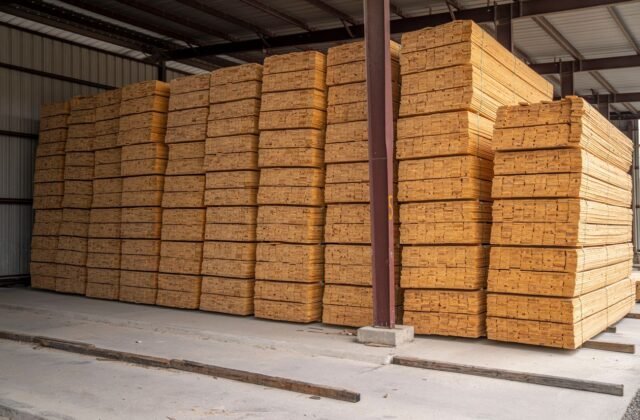
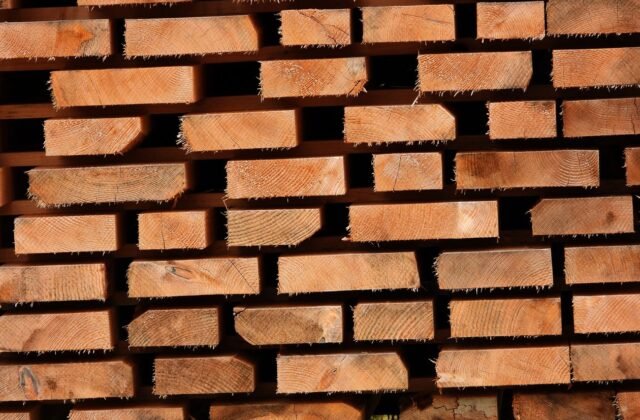
- Off the ground on stickers (spacer strips) or skids — never flat on soil or concrete where one face stays wet.
- Stacked flat with stickers between layers so air circulates; sticker-stack the pile, don’t lean boards against a wall.
- Covered on top, open on the sides — a tarp over the top sheds rain while airflow through the sides equalizes moisture.
- Out of sustained direct sun if possible; uneven solar heating is what twists a pile in a weekend.
Cut Smart: Seal Every Field Cut
The preservative penetrates from the outside in — every cut exposes less-protected inner wood. Brush a copper-based cut-end preservative (about $10–$15 per can) on every field cut, especially post bottoms and buried ends. It’s the cheapest longevity insurance in the project. Other cutting practices:
- Cut outdoors or in ventilated space; never cut treated lumber indoors without dust extraction.
- Wear a dust mask (N95 or better), eye protection, and gloves. Wash hands before eating; launder work clothes separately.
- Never burn treated offcuts — the ash concentrates the preservative chemicals. Dispose of scraps through normal waste or per local rules.
- Collect sawdust rather than leaving it in garden beds or play areas.
Fasten for the Treatment, Not Just the Load
Modern ACQ and MCA treatments are corrosive to plain steel. Use hot-dip galvanized (ASTM A153) or stainless steel (304/316) fasteners and connectors throughout — including joist hangers and post bases. Never use electro-galvanized or plain steel outdoors, keep aluminum flashing from direct contact with ACQ lumber (separate with a barrier), and don’t mix stainless and galvanized fasteners in the same connection where they’ll sit wet. Fastener failure, not wood failure, ends most PT structures early.
Install with Movement in Mind
- Gap decking 1/4 in (6 mm) for drainage and expansion — tight-butted wet boards shrink open; dry boards swell shut.
- Crown joists upward (the slight arch all lumber has) so floors stay flat under load.
- Predrill near ends on dense southern pine to prevent splitting, especially with screws within 3/4 in (19 mm) of a board end.
- Set posts 6 in (150 mm) above concrete footings on post bases where code allows, rather than burying — buried posts rot from the ground line up even when UC4A rated.
Related Guides
- Complete Guide — the full overview of PT lumber estimating.
- Material Guide — ratings, treatments, species, and grades.
- Common Mistakes — what goes wrong when these tips are skipped.
- Estimating Guide — step-by-step takeoff with a worked deck example.
- Pre-Order Checklist — verify everything before the lumber order.
Get Your Number
Good buying is a second estimate: the Pressure Treated Lumber Calculator tells you how many boards to buy, and these practices make sure the boards you buy are the right ones — correct UC rating off the end tag, straight stock, proper storage, sealed cuts, and corrosion-proof fasteners. Do the quantity math first, then shop with the checklist in hand.
Disclaimer: Calculator results are planning estimates only — actual material needs vary with site conditions, cutting losses, board quality, and product availability. Follow manufacturer safety guidance when cutting and handling treated lumber, verify quantities with your supplier, and consult a licensed professional for structural or code-related decisions.