Introduction
Every gravel project — a driveway, a garden path, a drainage bed — starts with the same question: how much gravel do you actually need? Order too little and the delivery truck leaves before the job is done; order too much and you’re paying to haul away the surplus. Gravel estimating answers that question with arithmetic instead of guesswork: measure the area, decide the depth, compute the volume, and convert to the tons or cubic yards your supplier sells by.
The Gravel Calculator handles the core calculation: enter your length, width, and depth, and it returns the required volume in cubic meters and cubic yards, plus the approximate weight in tons. This guide explains everything behind that number — the gravel types, the depth rules, a full worked example, and the judgment calls the calculator can’t make for you.
What Gravel Estimating Is and Where It’s Used
Gravel is sold by volume (cubic yards or cubic meters) or by weight (tons or tonnes), so the fundamental task is converting your project’s dimensions into the unit your supplier quotes. The people who need this math:
- Homeowners and DIYers building driveways, walkways, patios, garden beds, and shed bases.
- Contractors pricing drainage work, road base, parking areas, and landscaping projects.
- Landscapers estimating decorative stone, mulch alternatives, and xeriscaping coverage.
- Builders ordering sub-base material for slabs, foundations, and utility trenches.
The geometry is almost always the same — a flat area at a specified depth — which makes gravel one of the simplest materials to estimate. The complexity lives in the choices: which gravel type, how deep, and whether your supplier sells by the yard or by the ton. Get those three right and the arithmetic is straightforward.
Gravel Types and What They’re For
Not all gravel behaves the same. The four types you’ll encounter most:
Pea Gravel
Small, rounded stones roughly 6–10 mm (¼–⅜ in) in diameter, naturally tumbled smooth. Comfortable underfoot, which makes it the default for walkways, patios, playgrounds, and dog runs. Because the stones are rounded, pea gravel doesn’t compact or lock together — it shifts under weight, so it’s a poor choice for driveways where tires will displace it. Typical depth: 5–7.5 cm (2–3 in).
Crushed Stone
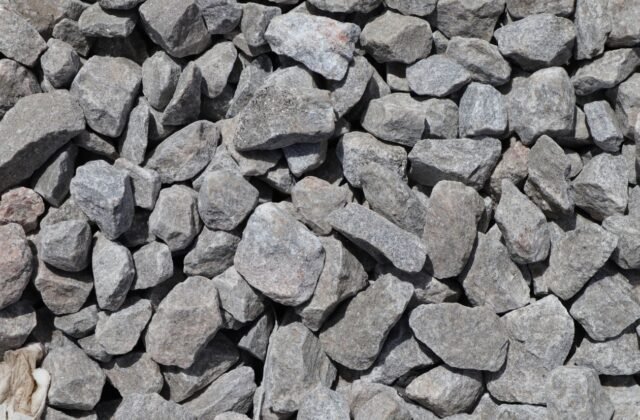
Angular rock mechanically crushed to size — commonly 20 mm (¾ in) or “¾-inch minus” which includes fines. The sharp edges interlock under compaction, creating a firm, load-bearing surface. This is the workhorse for driveways, road base, and shed foundations. The fines fill voids between larger pieces, so compacted crushed stone sheds water while staying solid. Typical driveway depth: 10–15 cm (4–6 in) over a prepared subgrade.
River Rock
Large, smooth stones from 25 mm to 150 mm (1–6 in), valued for appearance rather than function. Used in decorative beds, dry creek features, and erosion control where the visual matters more than walkability. Because the pieces are large and irregular, coverage per ton is lower — budget extra depth (7.5–10 cm / 3–4 in minimum) so the ground doesn’t show through. For drainage applications, washed river rock in a French drain is a standard choice.
Decomposed Granite
Finely crushed granite that packs down almost like pavement when compacted with water. Popular for natural-looking paths, patios, and xeriscaping in dry climates. It needs a stabilizer or regular re-compaction in high-traffic areas, and it can track indoors on shoes. Typical depth: 5–7.5 cm (2–3 in) over compacted base.
A fuller comparison — including crusher run, road base, and specialty aggregates — is in the gravel material guide.
Key Terms and Variables
The calculator asks for four inputs:
Length and Width
The two horizontal dimensions of the area, in meters or feet. Measure the actual area to be covered — not the surrounding lawn or the rough outline. For driveways, measure the full driving surface including any turnarounds or parking pads.
Depth
How thick the gravel layer will be, in centimeters or inches — and the input most people get wrong. Depth depends on the application and the gravel type:
| Application | Recommended depth |
|---|---|
| Garden paths, patios (pea gravel, decomposed granite) | 5–7.5 cm (2–3 in) |
| Decorative beds (river rock) | 7.5–10 cm (3–4 in) |
| Residential driveways (crushed stone) | 10–15 cm (4–6 in) |
| Heavy vehicle / commercial driveways | 15–20 cm (6–8 in) |
| Drainage trenches (washed stone) | Per design — often 15–30 cm (6–12 in) |
Waste %
The allowance for compaction, spillage, and uneven subgrade. Gravel compacts 10–20% under rolling or tamping, which means a loose 15 cm layer settles to roughly 12–13.5 cm. The default 10% suits most projects; use 15% for soft subgrades or deep fills. Measurement technique for irregular areas is covered in the estimating guide.
The Formulas Involved
Formula 1: Volume
Volume = Length × Width × Depth × (1 + Waste%)
All three dimensions in consistent units. The result is in cubic meters (metric) or cubic feet (imperial), converted to cubic yards by dividing by 27.
Formula 2: Cubic Yards to Tons
Tons ≈ Cubic Yards × 1.5 (range 1.4–1.7 depending on stone type and moisture)
This is the conversion most people need, because quarries often sell by the ton while the project is measured by the yard. Pea gravel runs lighter (~1.4 tons/yd³); dense crushed stone runs heavier (~1.6–1.7 tons/yd³). When in doubt, ask your supplier for the bulk density of the specific product — it’s the only exact number. The derivation is explained in the formula-explained guide.
Worked Example: Driveway in Both Unit Systems
A driveway 12 m long, 3 m wide, with 12 cm (0.12 m) of crushed stone and 10% waste:
Step 1 — Volume. 12 × 3 × 0.12 = 4.32 m³; × 1.10 = 4.75 m³.
Step 2 — Cubic yards. 4.75 ÷ 0.7645549 = 6.21 yd³.
Step 3 — Tons. 6.21 × 1.5 = 9.3 tons (order 10 tons).
Cross-check in imperial — 39.37 ft × 9.84 ft × 4.72 in: 4.72 ÷ 12 = 0.393 ft; 39.37 × 9.84 × 0.393 = 152.3 ft³; ÷ 27 = 5.64 yd³; × 1.10 = 6.21 yd³. Identical.
Practical takeaway: at ~10 tons, this is a single tri-axle dump truck load in most markets — one delivery, not several. For pricing that quantity with local rates, see the cost guide.
Base Preparation Matters More Than the Math
The calculator gives you the gravel quantity. What it can’t give you is a stable base — and gravel on an unprepared base migrates, ruts, and disappears into mud:
- Excavate and compact the subgrade. Remove topsoil and organic matter; compact the soil beneath.
- Lay landscape fabric (weed barrier). It separates gravel from soil, suppresses weeds, and prevents the stone from sinking into mud. Overlap seams by 15 cm (6 in).
- Install edging first. Steel, aluminum, plastic, timber, or stone edging keeps gravel from migrating into lawns and beds. This is the step DIYers skip most — and regret most.
- Compact in lifts. For depths over 10 cm (4 in), place and compact in two layers rather than one deep one.
- Crown or slope for drainage. A driveway should shed water to the sides — roughly 2% cross-slope (2 cm per meter, or ¼ in per foot).
Base prep details, including drainage design, are in the pro tips guide.
Mistakes That Distort Results
- Forgetting compaction. Ordering the exact geometric volume leaves you 10–20% short after the roller passes. The waste allowance exists for this.
- Measuring the wrong area. Estimating the lawn instead of the path, or the rough outline instead of the finished edges.
- Using one depth for the whole job. Driveways need more depth in the wheel tracks; paths need less at the edges. Average honestly.
- Confusing tons and cubic yards. A “10-yard” order and a “10-ton” order differ by roughly 50%. Confirm the unit with your supplier before ordering.
- Skipping the weed barrier. Not a math error, but the most expensive omission — weeds through gravel are miserable to fix retroactively.
- No edging. Uncontained gravel migrates. The estimate was right; the installation wasn’t.
Each of these is dissected further in the common mistakes guide.
Related Guides
- Gravel Calculator FAQ — quick answers to the most asked questions.
- Gravel Material Guide — types, sizes, and which stone suits which job.
- Gravel Cost Guide — pricing by type, quantity, and region.
- Pro Tips — base prep, compaction, and installation advice.
- DIY vs Pro — when to spread it yourself and when to hire.
- Gravel Project Checklist — everything to verify before ordering.
Frequently Asked Questions
How many tons of gravel do I need for a driveway?
A typical residential driveway (12 m × 3 m at 12 cm deep) needs about 6.2 cubic yards, or roughly 9–10 tons of crushed stone. Measure your actual dimensions and use the calculator — driveway sizes vary enormously.
How deep should gravel be for a driveway?
10–15 cm (4–6 in) of compacted crushed stone over a prepared base for residential driveways; 15–20 cm (6–8 in) for heavy vehicles. Walkways and patios need only 5–7.5 cm (2–3 in).
How many cubic yards are in a ton of gravel?
About 0.6–0.7 cubic yards per ton (inverse of the 1.4–1.7 tons/yd³ bulk density). So 10 tons ≈ 6–7 cubic yards. Confirm with your supplier — density varies by stone type.
Should I put landscape fabric under gravel?
Yes, for almost every application. It prevents weeds, stops gravel from sinking into mud, and makes future removal far easier. Overlap seams 15 cm (6 in) and choose a woven fabric for driveways.
Does gravel need to be compacted?
Crushed stone and road base — yes, with a plate compactor or roller, in lifts. Pea gravel and river rock — no, they’re decorative and meant to stay loose. Decomposed granite benefits from water and rolling.
Metric or imperial — which should I use?
Whichever your supplier quotes in. If gravel is sold by the ton and your tape is in feet, use imperial; if by the tonne or cubic meter, use metric. Never mix systems within one calculation.
Get Your Number
Gravel estimating is area times depth, converted to your supplier’s unit: measure carefully, pick a realistic depth for the application, add waste for compaction, and confirm tons vs. cubic yards before ordering. The Gravel Calculator does the arithmetic — your job is the tape measure and the base prep. Run your dimensions, price it with two local suppliers, and don’t skip the weed barrier or the edging.
Disclaimer: Calculator results are planning estimates based on the dimensions you enter. Actual gravel requirements vary with stone type, compaction, subgrade conditions, and supplier bulk density. Verify quantities with your supplier and consult a licensed professional for structural, drainage, or code-related decisions.
1 comment