Gravel Calculator FAQ: Questions Answered
How much gravel for a driveway? Tons or cubic yards? Fabric or no fabric? This page answers the most common questions about the Gravel Calculator, from depth rules to delivery logistics. If your question isn’t answered here, the complete guide covers the full estimating process in depth.
How much gravel do I need for a driveway?
Measure length × width × depth. A typical residential driveway of 12 m × 3 m (40 ft × 10 ft) at 12 cm (5 in) of crushed stone needs about 6.2 cubic yards, or roughly 9–10 tons. Your dimensions will differ — plug them into the Gravel Calculator for an exact figure, and add 10% for compaction.
How deep should gravel be?
It depends on the use: 5–7.5 cm (2–3 in) for garden paths and patios; 7.5–10 cm (3–4 in) for decorative beds; 10–15 cm (4–6 in) compacted for residential driveways; 15–20 cm (6–8 in) for heavy vehicles. These are finished, compacted depths — spread about 15–20% deeper to allow for settlement. The complete guide has a full depth table.
How many tons are in a cubic yard of gravel?
Typically 1.4–1.7 tons per cubic yard, depending on stone type: pea gravel ≈ 1.4, crushed stone ≈ 1.5–1.65, crusher run ≈ 1.55–1.7. The calculator uses 1.5 as a middle-ground default. Inversely, one ton is about 0.6–0.7 cubic yards. Ask your supplier for the exact bulk density of their product — it’s the only precise number. See the formula-explained guide for the derivation.
Should I put landscape fabric under gravel?
Yes, for nearly every application. Fabric suppresses weeds, prevents gravel from sinking into mud, separates the stone from the soil, and makes any future removal dramatically easier. Use woven fabric for driveways and paths, non-woven where drainage is the priority. Overlap seams 15 cm (6 in). Skipping fabric is the most regretted shortcut in gravel work.
What is the best gravel for a driveway?
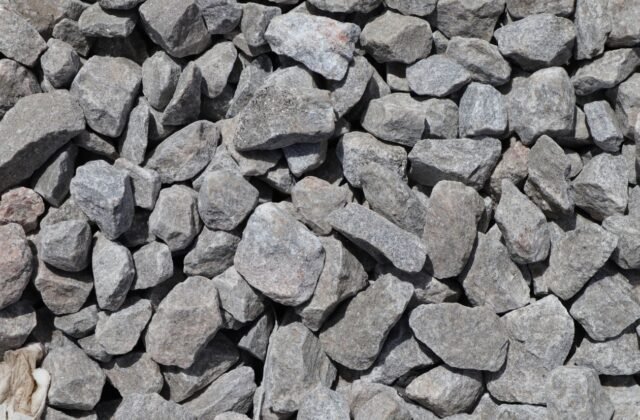
Crushed angular stone — typically 20 mm (¾ in) crushed or crusher run (¾-inch minus with fines). The angular faces interlock under compaction into a firm surface that resists displacement by tires. Avoid pea gravel and river rock for driveways; rounded stones migrate constantly under vehicles. Depth and base prep matter as much as the stone choice — see the material guide.
Can I just dump gravel on dirt or grass?
You can, but you shouldn’t. Grass grows through, organics decompose into voids, and the stone sinks into soft soil within a season. Proper sequence: excavate topsoil, compact the subgrade, lay fabric, install edging, then spread gravel. The pro tips guide walks through each step.
How much does gravel cost?
Broad ranges: $15–$45 per ton for basic crushed stone and crusher run in bulk; $25–$55 for pea gravel; $45–$120+ for decorative river rock. Delivery adds roughly $50–$150 per local truckload. Bagged gravel costs 3–5× more per ton than bulk. The cost guide breaks down bulk vs. bags, delivery, and the extras (fabric, edging) people forget to budget.
Does gravel need edging?
Yes — uncontained gravel migrates into lawns and beds with rain and foot traffic. Steel, aluminum, timber, stone, or heavy-duty plastic edging, installed before spreading, keeps the stone where it belongs. Set it 1–2 cm (½ in) above finished gravel height.
How do I calculate gravel for an irregular shape?
Divide the area into rectangles (and circles or triangles if needed), calculate each separately, and add the volumes. For curved beds, approximate with a series of rectangles — slight overestimation is fine and covered by the waste allowance. The estimating guide shows the technique with a worked L-shaped example.
Can gravel be delivered in winter?
Yes, though frozen ground complicates base prep — excavation is harder and compaction is less effective on frozen subgrade. If the ground is frozen, it’s often better to wait for a thaw. Suppliers generally deliver year-round, but spring is peak season with the longest lead times; ordering in late fall or winter can mean faster delivery and occasionally better pricing.
How long does a gravel driveway last?
A properly built crushed-stone driveway (excavated base, fabric, edging, compacted in lifts, crowned for drainage) typically lasts 10–15 years before needing major rework, with light top-ups every 2–3 years. A driveway dumped on unprepared ground may need redoing in 2–3 years. The base prep — not the stone — determines longevity. See pro tips for the full installation sequence.
Will gravel kill grass underneath?
Yes — 5+ cm of gravel over landscape fabric smothers grass within weeks by blocking light. That’s usually the intent for paths and beds. If you want grass to survive (it won’t under a driveway), don’t use gravel there. For areas transitioning between lawn and gravel, install edging first to keep the boundary crisp — a clean edge is what makes the combination look intentional rather than neglected.
Is gravel cheaper than concrete or pavers?
Substantially — typically one-third to one-half the installed cost of concrete for a driveway, and far less than pavers. A 40 m² (430 ft²) gravel driveway might run $600–$1,000 DIY versus $2,500–$5,000+ for concrete. The trade-off is maintenance: gravel needs periodic raking and top-ups; concrete doesn’t. There’s also a middle ground — some homeowners do gravel now and pave later, using the gravel years as an extended test of the layout and drainage before committing to concrete. The DIY vs. pro guide compares total costs including labor.
Metric or imperial — which should I use?
Whichever your supplier quotes in. Sold by the ton with a tape in feet? Use imperial. Sold by the tonne or cubic meter? Use metric. The calculator handles both — just keep all inputs in one system within a single calculation.
Estimate your gravel
Enter length, width, and depth in the Gravel Calculator for volume in m³ and yd³ plus approximate tons — in metric or imperial. Figures are estimates; verify with your supplier before ordering. If you’re deciding between stone types, the material guide can help you choose first.