Introduction
Every PVC job — irrigation, drain, pool return — starts with one question: how much pipe and how many fittings do you need? Buy too little and you’re making a mid-project supply run; buy too much and you own sticks you’ll never use. A takeoff answers with arithmetic: measure runs, count fittings, add waste.
The PVC Pipe Calculator handles the core calculation: enter runs, fittings, size, schedule, and waste, and it returns sticks to buy, fitting totals, and pressure limits. This guide explains what’s behind that number — terminology, formulas, a worked example, and the judgment calls the calculator can’t make.
What a PVC Pipe Takeoff Is and Where It’s Used
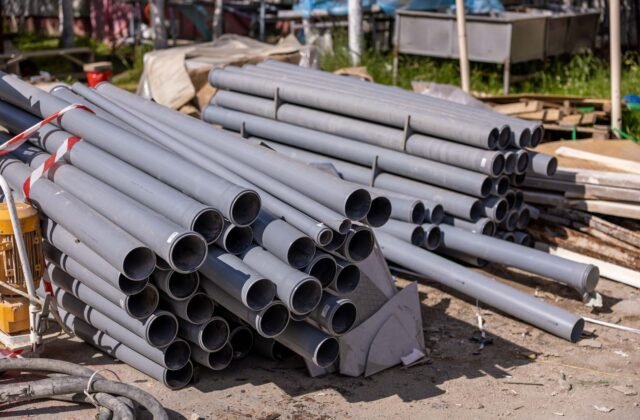
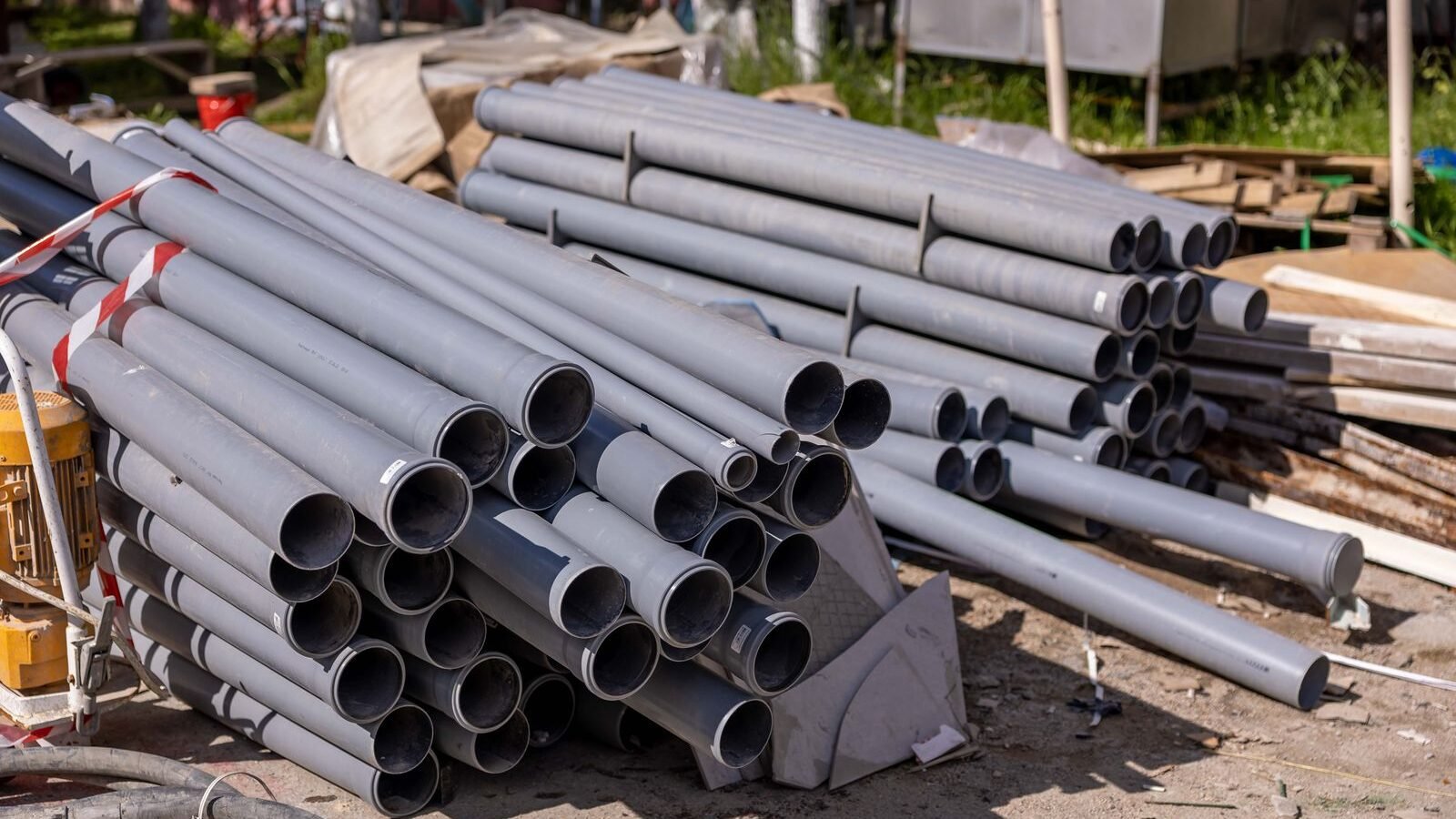
PVC pipe is sold in straight lengths — most commonly 10-foot (3.05 m) sticks — while fittings are sold individually. So every estimate has two halves: total the pipe and count the fittings. The people who need this math:
- Homeowners and DIYers running irrigation, pool plumbing, sump discharge lines, or drain/waste/vent (DWV) pipe.
- Irrigation and landscape contractors pricing laterals, mains, and manifold assemblies.
- Plumbers and builders doing DWV rough-ins, water service laterals, and rainwater systems.
- Estimators pricing materials for water mains, sewer laterals, and site utilities.
You’ll estimate straight runs (totaled, divided by stick length), fittings (counted from the layout), jointing materials (primer and cement), and supports (hangers, straps, bedding).
For a plan-based takeoff, see the estimating guide; for the budget number, the cost guide.
Key Terms and Variables
The calculator asks for a handful of inputs:
Nominal pipe size (NPS)
Trade sizes: 1/2″, 3/4″, 1″, 1-1/2″, 2″, 3″, 4″, and up. For PVC, nominal size is not a measured dimension: 2″ pipe is 2.375 in (60.3 mm) OD, ~2.047 in (52.0 mm) ID in Schedule 40. Size by NPS; check OD when matching adapters or tools.
Schedule (40 / 80)
The wall-thickness standard (ASTM D1785). Same NPS, same outside diameter — Schedule 80 just has a thicker wall, smaller ID, and higher rating. Schedule 40 (white) is the residential default; Schedule 80 (gray) suits higher-pressure or exposed service.
SDR and C900
SDR (OD ÷ wall thickness) grades pipe by proportion — SDR-35 (ASTM D3034) is gasketed sewer/drain pipe; C900 (AWWA C900) is blue gasketed water-main pipe, 4″+. Neither uses solvent-weld fittings.
Run lengths
Every straight segment, fitting-center to fitting-center — including vertical risers, not just plan-view distance.
Fitting counts
Every elbow, tee, wye, coupling, reducer, adapter, union, cap, and valve — each a socket needing primer and cement. Count from the layout, not from memory.
Waste %
The allowance for cutoffs, bad cuts, and measuring slack — 10% default, up to 15% for complex layouts. Apply waste to pipe footage, not fittings; buy 1–2 spare elbows and couplings instead.
| Situation | Suggested waste allowance |
|---|---|
| Long straight runs, few cuts | 5–10% |
| Typical residential irrigation or DWV | 10% |
| Many short pieces, repairs, tight spaces | 10–15% |
| Working from a rough sketch, no firm layout | 15–20% |
The Formulas Involved
The calculator runs four calculations in sequence:
Formula 1: Total pipe
Total pipe = (sum of all run lengths) × (1 + Waste%). Keep every run in the same units before adding — one mixed unit corrupts the whole total.
Formula 2: Sticks to buy
Sticks = Total pipe ÷ stick length, rounded up. With 10-ft (3.05 m) sticks, 47.3 ft means 4.73 → 5 sticks. Always round up — a stick short is a project stop.
Formula 3: Coupling estimate
Couplings ≈ (Sticks − 1) − (fittings that already join two sticks). Count couplings from the layout; the formula is just a sanity check.
Formula 4: Temperature-derated pressure rating
Working pressure = stamped rating × derating factor. Ratings assume 73°F (23°C); heat derates fast — ×0.62 at 100°F (38°C), ×0.22 at 140°F (60°C). See the material guide before sizing hot or sun-exposed pipe.
A deeper derivation of each step, with the derating math worked through, is in the formula-explained guide.
Worked Example: From Measurements to Shopping List
Example — 2″ Schedule 40 irrigation main: runs 25/40/15 ft; 4 elbows, 2 tees, 1 adapter; 10% waste.
Step 1 — Total. 25 + 40 + 15 = 80 ft; × 1.10 = 88 ft.
Step 2 — Sticks. 88 ÷ 10 = 8.8 → 9 sticks.
Step 4 — Couplings and jointing. 9 sticks → 8 joints; 2 at fittings → 6 couplings + 1 spare. 13 socket joints total — one quart each of primer and cement (covers ~30–40 two-inch joints) is plenty.
Cross-check in metric — 7.6 + 12.2 + 4.6 = 24.4 m; × 1.10 = 26.8 m; ÷ 3.05 = 8.8 → 9 sticks. Same answer.
Practical takeaway: the pipe is less than half the materials bill — fittings, valves, primer, and cement make up the rest. Price the full list, not just the sticks; the cost guide breaks that down.
Common Variations
The calculator takes straight runs and fitting counts; real systems come in flavors. Adapt like this:
- DWV (drain/waste/vent): use DWV-rated fittings (sweeps and wyes, not sharp pressure elbows). Pitch 1/4 in per ft (2%) for 3″ and smaller, 1/8 in per ft (1%) for 4″ and up; include the vertical drop in measurements.
- Irrigation mains and laterals: size the main for total flow, laterals per zone. Add a tee + cap at each low point for drainage in freezing climates.
- Water service (C900, 4″+): gasketed bell-and-spigot joints instead of solvent weld — count bells, not couplings, and budget bedding/thrust-block material.
- Pool and spa plumbing: Schedule 40 is standard; add unions at pump and filter — every future repair starts by thanking whoever installed a union.
- Repairs and tie-ins: slip-fix (telescoping) and repair couplings count explicitly — one repair coupling replaces a cut-out section.
The rule for any complex layout: draw the system, number every fitting, count from the drawing. Memory-based counts are where takeoffs die. The estimating guide shows the plan-based workflow.
Mistakes That Distort Results
- Measuring face-to-face instead of center-to-center. Socket depth (1–2 in / 25–50 mm per end) absorbs inches of pipe per joint; face-to-face layouts run short.
- Not rounding sticks up. 4.7 sticks is 5 sticks — you can’t buy 0.7 of one.
- Forgetting Schedule 40 and 80 share OD but differ in ID. Fittings are sized by nominal size, but flow capacity and threaded connections care about the difference.
- Skipping waste. Zero waste is a plan for a second supply run — and the second run costs more than the 10% would have.
- Ignoring temperature derating. A 280-psi pipe at 73°F is ~174 psi at 100°F. Hot water, sun-baked risers, and pump rooms derate fast.
- Mixing DWV and pressure fittings. Different products, different jobs — the mix-up fails inspection or bursts, sometimes both.
A fuller catalogue of these errors, with fixes, is covered in the common mistakes guide.
Related Guides
- Estimating Guide — step-by-step takeoff from plans or a sketch.
- Material Guide — Schedule 40 vs 80, SDR-35, C900, and fitting selection.
- Cost Guide — typical pipe, fitting, and jointing costs.
- Pro Tips — dry-fitting, solvent-weld technique, and field tricks.
- PVC Pipe Calculator FAQ — quick answers to common questions.
- Materials Checklist — everything to buy before the first cut.
Frequently Asked Questions
How many 10-foot sticks do I need for 80 feet of pipe?
88 ft with 10% waste ÷ 10 ft = 8.8 → 9 sticks. Always round up.
What’s the difference between Schedule 40 and Schedule 80 PVC?
Same outside diameter per nominal size, but Schedule 80 has a thicker wall, smaller ID, and higher pressure rating. Schedule 40 is the residential default; Schedule 80 suits higher-pressure, industrial, or exposed service.
How much waste should I add to a PVC estimate?
Ten percent standard; 5–10% for long straight runs, 10–15% for many short pieces or repairs, 15–20% from a rough sketch.
Do I need primer with solvent cement?
Yes — primer cleans and softens the surfaces so the cement can fuse them, and plumbing codes require it. Skipping primer is the most common cause of joint failure.
Can I use threaded PVC fittings?
Yes, but threaded joints cut the pressure rating to roughly half, and over-tightening cracks female threads. Use thread-sealant tape and don’t overtighten.
Is PVC pipe sized by inside or outside diameter?
Neither — it’s sized by nominal pipe size (NPS), a trade designation. OD is fixed per NPS (2.375 in / 60.3 mm for 2″); ID varies with schedule.
Get Your Number
Total your runs, divide by stick length and round up, count fittings from a drawing, add realistic waste. The PVC Pipe Calculator does the arithmetic — your job is the tape measure and the sketch.
Disclaimer: Calculator results are planning estimates based on your inputs. Actual needs vary with site conditions and layout accuracy. Verify pressure ratings and code requirements locally, and consult a licensed professional for pressurized, potable-water, or code-regulated work.