Introduction
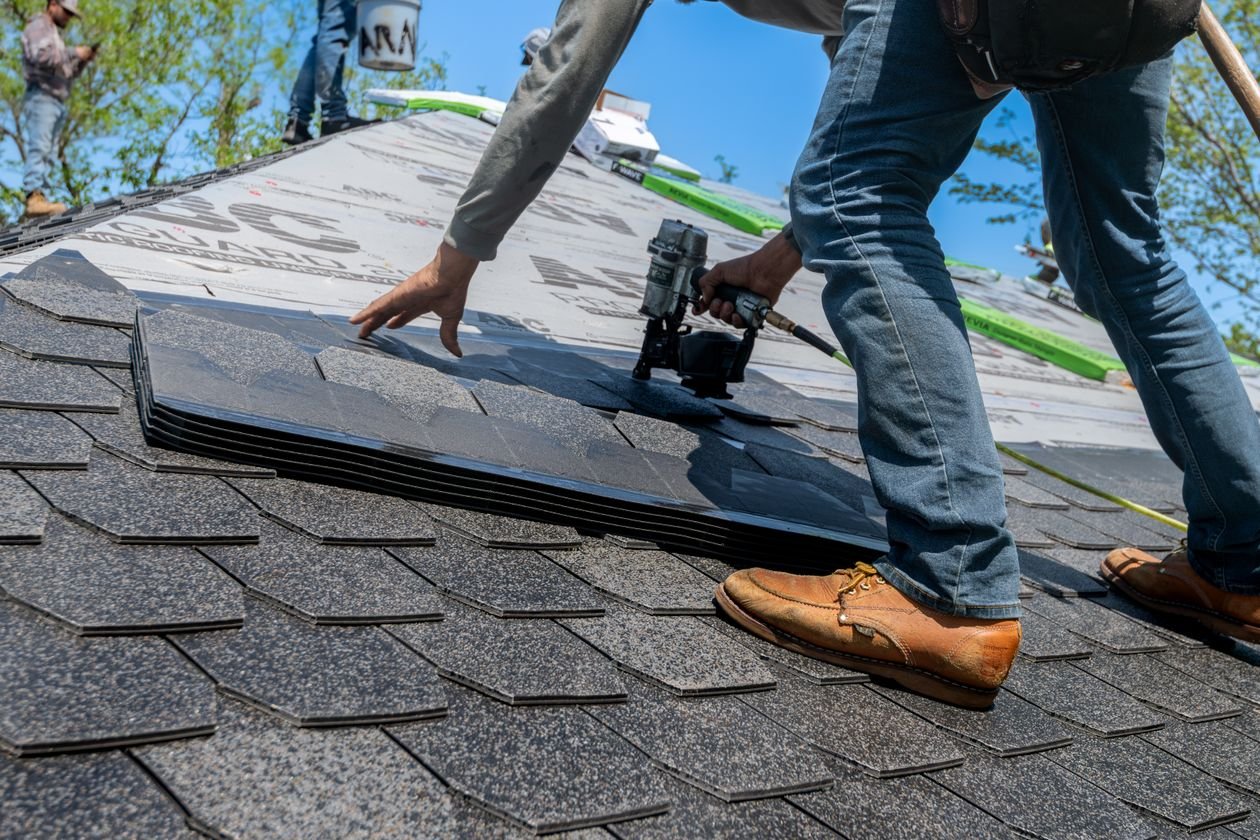
Every re-roofing project starts with the same question: how much roof do you actually have, and what will it cost to cover it? Guess the area and the material order is wrong; guess the price and the budget falls apart. Roofing cost estimating answers both with measurement instead of guesswork: measure the footprint, correct for pitch, convert to roofing squares, then build the cost from materials, labor, tear-off, and the accessories every roof needs.
The Roofing Cost Calculator handles the core calculation: enter your footprint dimensions, roof pitch, and waste allowance, and it returns the roof area in squares and square meters, the shingle bundles to order, and a cost estimate you can sanity-check against contractor quotes. This guide explains everything behind that number — the terminology, the formulas, a full worked example, and the judgment calls the calculator can’t make for you.
What Roofing Cost Estimating Is and Where It’s Used
A roofing estimate converts roof geometry into quantities and then into money. Unlike a floor plan, a roof’s true area exceeds its footprint — the slope adds surface — and the price depends on more than the covering: tear-off, underlayment, flashing, ventilation, and labor all have a say. The people who need this math:
- Homeowners planning a re-roof and judging whether quotes are reasonable.
- Roofing contractors turning measurements into competitive, profitable bids.
- Buyers and sellers pricing a roof near the end of its life.
- Adjusters and property managers scoping repair and replacement costs after storms.
The calculator gives the planning number — roof area, material quantities, an indicative cost. The contractor gives the final number, shaped by labor rates, complexity, and code. The closer your estimate, the better you can tell a fair quote from an inflated one. For a line-by-line breakdown of what quotes contain, see the roofing cost guide.
Key Terms and Variables
Key terms, each mapping to a calculator input or output:
Roofing Square
The industry’s unit of area: one square = 100 ft² ≈ 9.29 m². Shingles, underlayment, and labor are commonly priced per square — a 2,000 ft² roof is “20 squares” in trade language.
Pitch
Roof steepness as rise over a 12-unit run — 6/12 rises 6 inches per 12 inches of run (≈ 26.6°). Pitch sets the pitch factor, walkability, labor difficulty, and sometimes material options.
Pitch Factor
The multiplier converting footprint to sloped area: pitch factor = √(1 + (rise/run)²). At 6/12 it’s ≈ 1.118, so a 1,000 ft² footprint becomes 1,118 ft² of roof.
| Pitch | Degrees | Pitch factor |
|---|---|---|
| 3/12 | 14.0° | 1.031 |
| 4/12 | 18.4° | 1.054 |
| 5/12 | 22.6° | 1.083 |
| 6/12 | 26.6° | 1.118 |
| 7/12 | 30.3° | 1.158 |
| 8/12 | 33.7° | 1.202 |
| 9/12 | 36.9° | 1.250 |
| 10/12 | 39.8° | 1.302 |
| 12/12 | 45.0° | 1.414 |
Waste %
The allowance for cutting, trimming, starter courses, ridge caps, and the offcuts that hips, valleys, and dormers generate. The default 10% suits simple gable roofs; cut-up roofs typically need 12–15%.
Tear-Off
Removing the existing roofing down to the deck before installing the new one. One layer versus two changes labor and disposal substantially — and most codes cap shingle layers (commonly two; verify locally), deciding whether tear-off is optional or mandatory.
Underlayment and Accessories
The layers and trims that make a roof a system: felt or synthetic underlayment, ice-and-water shield in cold climates, drip edge, flashing, ridge cap, and ventilation — often 10–20% of the material bill. See the material guide for the full component tour.
The Core Calculation
The calculator runs four steps in sequence — each step’s output feeds the next, so an early error compounds:
Step 1: Roof area
Roof area = Footprint length × Footprint width × Pitch factor. The footprint is the horizontal area the roof covers, measured at the roof edge in feet or meters. This is the most misunderstood step: the footprint is not the roof area.
Step 2: Convert to squares
Squares = Roof area ÷ 100 (ft²) or ÷ 9.29 (m²). Round up to a whole or half square — running short mid-job is worse than a small surplus.
Step 3: Shingle bundles
Bundles = Squares × Bundles per square × (1 + Waste%), rounded up. Architectural shingles typically run 3 bundles per square; some 3-tab lines need 4. Bundle counts always round up to whole bundles.
Step 4: Cost estimate
Total ≈ (Squares × Material cost per square) + Labor + Tear-off/Disposal + Accessories + Permits. Material cost per square varies widely by material family and region, so the calculator treats it as an input. Labor is commonly the largest single line item — often roughly half the project total — rising with pitch, stories, and complexity. A full derivation of the geometry is in the formula-explained guide.
Worked Example: From Footprint to Bundle Count
Here’s a full pass from tape measure to material order: a house with a 30 ft × 40 ft footprint and an 8/12 pitch, with 12% waste.
Step 1 — Footprint. 30 × 40 = 1,200 ft².
Step 2 — Pitch factor. 8/12 → √(1 + (8/12)²) = 1.202.
Step 3 — Roof area. 1,200 × 1.202 = 1,442.4 ft².
Step 4 — Squares. 1,442.4 ÷ 100 = 14.42 → round to 14.5 squares.
Step 5 — Bundles. Architectural shingles at 3 bundles/square: 14.5 × 3 = 43.5; × 1.12 waste = 48.7 → round up to 49 bundles.
Cross-check in metric — 9.14 m × 12.19 m footprint: 111.4 m² × 1.202 = 133.9 m²; ÷ 9.29 = 14.41 squares, matching the imperial result. A fully worked hypothetical scenario is available in the case study.
What Moves the Number Beyond the Squares
Two roofs with identical squares can price very differently. The main levers: material family (asphalt is the most budget-friendly per square; metal often costs several multiples; tile and slate sit at the premium end), roof complexity (valleys, dormers, and skylights slow crews and generate waste), pitch and stories (steep and high means staging, safety systems, and slower work), tear-off layers (two layers roughly doubles stripping and disposal), and region and season (labor rates and demand vary). Learning to measure the footprint and pitch correctly is what makes the rest of the estimate trustworthy — the estimating guide walks through the ground-measurement method step by step.
Mistakes That Distort Results
Most roofing estimate errors are measurement and assumption errors, not arithmetic:
- Using the footprint as the roof area. Skipping the pitch factor understates the area by 5–40% depending on steepness — and the material order with it.
- Guessing the pitch. The difference between 6/12 and 8/12 is 8.4 squares on a 1,200 ft² footprint. Measure it; don’t eyeball it.
- Forgetting waste. A bare geometric area assumes a world with no cutting. Zero waste is a plan to run short.
- Ignoring tear-off layers. Assuming one layer when there are two understates disposal and labor.
- Forgetting accessories. Ridge cap, starter, underlayment, flashing, and vents are separate purchases — budget them or the “materials” number is fiction.
- Treating a quote as a single number. An un-itemized lump sum can’t be compared. Insist on per-square material, labor, tear-off, and accessory lines.
A fuller catalogue of these errors, with fixes, is covered in the common mistakes guide.
Related Guides
- Roofing Cost Guide — what each line of a roofing quote covers and how to budget for it.
- Roofing Cost Formula Explained — the pitch-factor math, squares, and waste allowance derived step by step.
- Estimating Guide — how to measure a roof’s footprint and pitch accurately from the ground.
- Material Guide — asphalt, metal, tile, and wood compared on lifespan, weight, and cost tier.
- Common Mistakes — the estimating errors that inflate or deflate a roofing budget.
- Roofing Cost FAQ — quick answers to the most asked roofing-estimate questions.
Frequently Asked Questions
What is a roofing square?
One square = 100 ft² ≈ 9.29 m² — the trade’s standard unit for pricing shingles, underlayment, and labor.
How much waste should I add?
Ten percent for simple gable roofs; 12–15% for roofs with valleys, hips, dormers, or many penetrations. When in doubt, round up — a few extra bundles are far cheaper than a stalled crew.
Does the calculator include labor?
The calculator estimates cost from your inputs, but labor rates vary enormously by region, pitch, and complexity — confirm with itemized local quotes.
Plan Your Roof Replacement
Roofing cost estimating is geometry first, shopping second: measure the footprint, correct for pitch, convert to squares, add realistic waste, then price materials, labor, tear-off, and accessories. The Roofing Cost Calculator does the arithmetic — your job is the tape measure. Run your numbers, then collect two or three itemized quotes.
Disclaimer: Calculator results are planning estimates based on the dimensions and rates you enter. Actual roofing costs vary with material choice, labor rates, roof complexity, deck condition, and local requirements. Get itemized quotes from licensed contractors and verify permit and code requirements with your local building authority before committing to a project.