Introduction
Ready-mix concrete is priced per cubic yard — but the per-yard price on a quote is only the start. Short-load fees, delivery charges, standing time, pump fees, and after-hours surcharges can add hundreds of dollars to an invoice if you don’t know they’re coming. The good news: every one of these charges is predictable, and most are avoidable with planning. This guide breaks down what ready-mix actually costs, line by line, with worked examples you can compare against your own quotes.
Start with the quantity that drives everything: the Ready Mix Concrete Calculator converts your dimensions into cubic yards with a waste allowance, giving you the exact number suppliers quote against.
The Price Components, Line by Line
Base price per cubic yard
The core charge: the mix itself, batched and delivered to the truck. In the US market this commonly falls in the $150–$200 per cubic yard range for standard residential mixes (3,000–4,000 psi), varying with region, fuel costs, and mix specification. Higher-strength mixes, small aggregate, air entrainment, or specialty admixtures each add to the per-yard figure. This is the number to compare when shopping suppliers — make sure every quote uses the same mix specification before comparing.
Delivery charge
Most suppliers charge a flat delivery or fuel fee per load, commonly $100–$150, sometimes built into the per-yard price for full truckloads. Multi-load pours may incur the fee per truck. Ask explicitly whether delivery is included in the quoted per-yard rate or added on top.
Short-load fee
Order below the supplier’s minimum — typically around 4–5 yd³ — and you pay a short-load fee, commonly $100–$200, because dispatching a half-empty truck costs the plant nearly as much as a full one. For small jobs this fee can exceed 20% of the material cost, which is why sub-4-yard pours deserve a hard look at bagged or trailer alternatives. The DIY vs pro guide runs the breakeven math.
Standing time (demurrage)
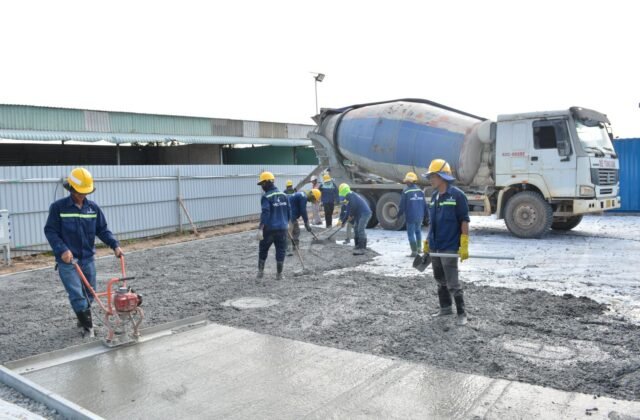
The price usually includes a free unload window — commonly 45–60 minutes per load. After that, the meter runs, often $1–$3 per minute. A short-handed crew or unprepared site converts directly into standing-time charges. This is the most avoidable fee on the invoice.
Pump fees
When the chute can’t reach, a pump is a separate service: a line pump or boom pump with an operator, commonly $500–$1,500+ depending on type and setup, plus a minimum charge even for short pumping sessions. On large pours the pump’s speed often pays for itself in reduced labor and standing time.
After-hours and weekend surcharges
Pours outside the plant’s normal operating hours — early morning, evenings, weekends — typically carry a surcharge, commonly $100–$300+ per load or per pour. Hot-weather scheduling sometimes makes an early pour worth the premium; budget for it.
| Charge | Typical range (US) | How to avoid or reduce it |
|---|---|---|
| Base concrete | $150–$200 / yd³ | Compare like-for-like mixes; order exact yardage |
| Delivery / fuel | $100–$150 / load | Ask if included; combine pours into fewer loads |
| Short load | $100–$200 | Order at or above the supplier minimum (~4–5 yd³) |
| Standing time | $1–$3 / min past free window | Have crew and equipment ready before the truck arrives |
| Pump service | $500–$1,500+ | Design access for chute discharge where possible |
| After-hours | $100–$300+ / load | Pour within normal plant hours |
These are indicative ranges for orientation only — actual prices vary widely by region, season, and supplier. Treat them as a sanity check on quotes, not as quotes themselves.
Worked Example: True Cost of a 6.25-Yard Pour
Take the 12 ft × 40 ft × 4 in driveway from the complete guide: 6.25 yd³ ordered, one truck, chute discharge, normal hours.
- Concrete: 6.25 yd³ × $175/yd³ = $1,093.75
- Delivery: $125 (one load) = $125
- Short-load fee: none — 6.25 yd³ exceeds the minimum
- Standing time: none — crew ready, unloaded in 40 minutes
- Pump: none — chute reaches
Total: $1,218.75, or about $195 per placed yard. Now watch what happens with poor planning on the same job: a 45-minute delay beyond the free window at $2/min adds $90; a short-handed finish needing a pump adds $700+; a Saturday pour adds $200. The same concrete can cost $1,219 or $2,200 depending on logistics — the material is the smaller variable.
In metric terms: 6.25 yd³ = 6.25 × 0.7645549 = 4.78 m³. At a metric-quoted price, the same arithmetic applies — multiply, add fees, compare.
Small-Job Economics: The Short-Load Trap
A 2-yd³ patio slab sounds cheap until the invoice arrives: 2 × $175 = $350 in concrete, plus a $150 short-load fee and $125 delivery = $625, or $312 per yard — nearly double the large-pour rate. Three options exist:
- Accept the truck anyway when schedule or mix consistency matters more than unit cost.
- Trailer pickup from the plant (where offered): you haul 1–2 yd³ in a rented trailer, paying near the per-yard rate with no short-load fee — but you’re racing the clock on a mix that’s already hydrating.
- Bagged concrete: 2 yd³ = 54 ft³ ÷ 0.6 ft³ per 80-lb bag = 90 bags. At ~$6/bag that’s $540 in bags alone plus a full day of mixing labor — competitive with the short-load truck only if your labor is free.
For most homeowners, the truck wins on anything above ~2 yd³ despite the fee; below that, the comparison is genuinely close. Run both numbers before deciding — the estimating guide gives you the yardage math that determines which side of the breakeven you fall on.
How to Compare Quotes Properly
Get at least two or three quotes, and make sure each one states the same specification: strength (psi/MPa), slump, aggregate size, air entrainment, admixtures, yardage, delivery address, pour date and time window, and every fee. A $160/yd³ quote with $250 in hidden fees is worse than a $175/yd³ all-in quote. Ask each supplier directly:
- Is delivery included in the per-yard price?
- What is the minimum load, and what is the short-load fee?
- How much free unload time is included, and what is the standing-time rate?
- What does a Saturday or early-morning pour cost?
- What is the cancellation/rescheduling policy?
The cheapest per-yard number on an incomplete quote is the oldest trick in the trade. Compare totals, not headlines. Once you’ve chosen a supplier, the pro tips guide covers how to brief the dispatcher and keep standing-time charges off the final invoice.
Related Guides
- Ready Mix Complete Guide — the full ordering process from estimate to washout.
- Ready Mix Estimating Guide — yardage math that keeps orders (and costs) accurate.
- DIY vs Pro for Ready Mix — breakeven math between truck, trailer, and bags.
- Ready Mix Pro Tips — ordering and pour-day tactics that keep fees off the invoice.
- Ready Mix FAQ — quick answers on fees, minimums, and charges.
- Ready Mix Material Guide — why mix specifications change the per-yard price.
Frequently Asked Questions
How much does ready-mix concrete cost per yard?
Commonly $150–$200/yd³ in the US for standard residential mixes, before delivery and fees. Region, mix specification, and season all move the number.
What is a short-load fee?
A surcharge — often $100–$200 — for ordering below the supplier’s minimum load (typically ~4–5 yd³), reflecting the cost of dispatching a partially filled truck.
Is delivery included in the per-yard price?
Sometimes for full loads, often not — a separate $100–$150 delivery or fuel fee per load is common. Ask explicitly.
How can I avoid standing-time charges?
Have the full crew, tools, and finishing equipment on site before the truck arrives, and keep placement continuous within the free unload window (usually 45–60 minutes).
Is a pump worth the cost?
When chute access is impossible, a pump is the only option. Even when optional, a pump’s speed can offset its fee on large pours by cutting labor hours and standing time.
Get a Number You Can Quote Against
Every cost estimate starts with an accurate yardage figure — order too much and you pay for concrete you don’t need; order too little and you pay dispatch fees twice. Run your dimensions through the Ready Mix Concrete Calculator, round up to the nearest quarter-yard, and take that number to two or three local suppliers for itemized quotes. The supplier with the lowest total — not the lowest per-yard headline — wins.
Disclaimer: Calculator results are planning estimates based on the dimensions you enter. Prices shown are indicative ranges only and vary by region, supplier, season, and mix specification. Verify all pricing and fees with your ready-mix supplier and consult a licensed professional for structural or code-related decisions.