Introduction
Every landscape rock order comes down to one chain of arithmetic: volume → cubic yards → tons. Suppliers sell and deliver by the cubic yard but bill by the ton, and the bridge between them is bulk density — how much a cubic yard of a particular rock actually weighs. The free Landscape Rock Calculator runs this chain for you, but understanding the formula lets you sanity-check quotes, adjust for rock type, and estimate in your head at the yard. This guide derives the formula step by step, with every worked example cross-checked in both imperial and metric units.
There are only three formulas to learn, and the third is the one most people get wrong. Work through them once and you will never over-order rock again.
Formula 1: Volume
For a rectangular bed, volume is simply:
Volume (ft³) = Length (ft) × Width (ft) × Depth (ft)
The trap is the depth unit. Depths are specified in inches, so convert first: divide inches by 12. A 3 in layer is 3 ÷ 12 = 0.25 ft. Forgetting this conversion — multiplying by 3 instead of 0.25 — is the classic order-of-magnitude blunder, and it produces a quote twelve times too large.
Worked example — rectangular bed: 20 ft × 4 ft at 3 in deep.
20 × 4 × 0.25 = 20 ft³.
Metric cross-check: 6.10 m × 1.22 m × 0.076 m = 0.566 m³ (20 ft³ × 0.02832 = 0.566 m³ ✓).
For non-rectangular beds, compute the area first, then multiply by depth:
| Shape | Area formula | Example |
|---|---|---|
| Circle | π × radius² | 8 ft diameter → π × 4² = 50.3 ft² |
| Ring (tree surround) | π × (R² − r²) | 5 ft outer, 2 ft inner → π × (25 − 4) = 66.0 ft² |
| Triangle | ½ × base × height | 12 ft × 6 ft → 36 ft² |
| Irregular | Grid method: count full + half squares | See the estimating guide |
Formula 2: Cubic Feet → Cubic Yards
Cubic yards = Cubic feet ÷ 27
(One cubic yard is a 3 × 3 × 3 ft cube = 27 ft³.) Continuing the bed example: 20 ft³ ÷ 27 = 0.74 yd³. Metric path: 0.566 m³ × 1.308 = 0.74 yd³ ✓ — both routes agree, as they must.
Why bother with cubic yards at all? Because that is the unit the dump truck thinks in. A full-size dump truck carries roughly 10–14 yd³; a small trailer load is 1–2 yd³. Knowing your cubic yards tells you instantly whether you are ordering a wheelbarrow-scale pickup or a truck-scale delivery.
Formula 3: Cubic Yards → Tons (Bulk Density)
Tons = Cubic yards × bulk density (tons/yd³)
Bulk density is the weight of one cubic yard of rock including the air gaps between stones — which is why it varies by rock type and size. Small, angular crushed stone packs tighter (denser) than large rounded river rock. Use these planning values:
| Rock type | Bulk density (tons/yd³) | Metric (t/m³) |
|---|---|---|
| Pea gravel | ~1.4 | ~1.66 |
| River rock (mixed sizes) | ~1.5–1.6 | ~1.78–1.90 |
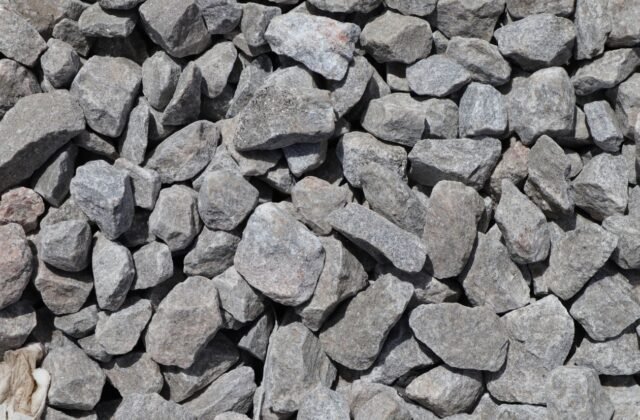
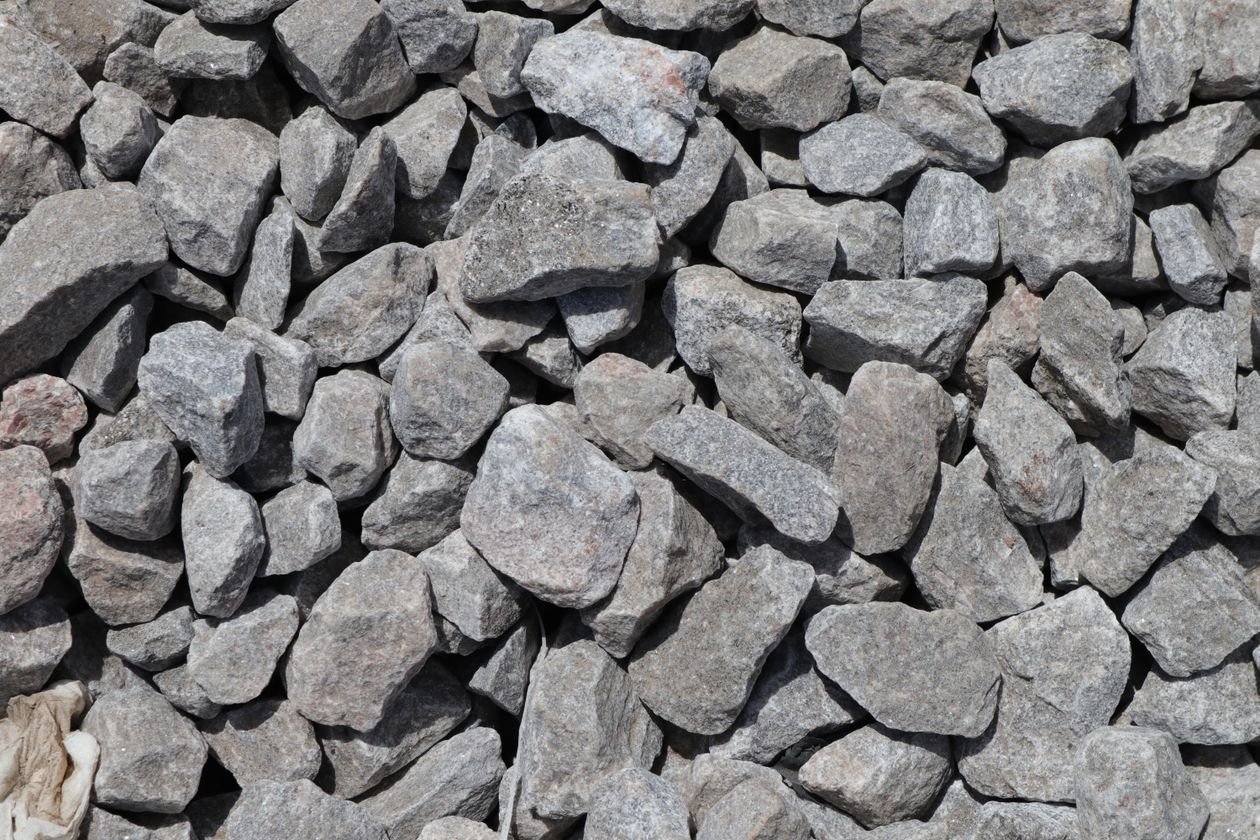
| Crushed decorative stone / granite | ~1.6–1.7 | ~1.90–2.02 |
| Mid-range planning factor | ~1.5 | ~1.78 |
Lava rock is the exception — its porous structure makes it far lighter, often under 1 ton/yd³. If you are ordering lava rock, ask the supplier for their specific bulk density rather than using the table. The material guide notes density quirks for each rock type.
Finishing the example: 0.74 yd³ × 1.5 = 1.11 tons. Add 5–10% waste for uneven ground and settling → order 1.2–1.5 tons.
Full Worked Examples (Dual-Unit Verified)
Example A: Circular bed, 8 ft diameter, 3 in of pea gravel
Area = π × 4² = 50.27 ft². Volume = 50.27 × 0.25 = 12.57 ft³ = 0.465 yd³. Pea gravel at 1.4 tons/yd³: 0.465 × 1.4 = 0.65 tons → order ~0.75 ton (or a full ton if the yard has a 1-ton minimum).
Metric: diameter 2.44 m, radius 1.22 m → area 4.68 m² × 0.076 m = 0.355 m³ = 0.465 yd³ ✓ → 0.65 tons ✓.
Example B: Tree ring, 5 ft outer / 2 ft inner radius, 3 in of river rock
Area = π × (25 − 4) = 65.97 ft². Volume = 65.97 × 0.25 = 16.49 ft³ = 0.611 yd³. River rock at 1.55 tons/yd³: 0.611 × 1.55 = 0.95 tons → order 1 ton.
Metric: outer 1.52 m, inner 0.61 m → area 6.09 m² × 0.076 m = 0.463 m³ = 0.605 yd³ ✓ → 0.94 tons ✓.
Example C: Garden path, 40 ft × 3 ft, 3 in of crushed granite
Volume = 40 × 3 × 0.25 = 30 ft³ = 1.111 yd³. Crushed granite at 1.6 tons/yd³: 1.111 × 1.6 = 1.78 tons → order ~2 tons.
Metric: 12.19 m × 0.91 m × 0.076 m = 0.843 m³ = 1.103 yd³ ✓ → 1.76 tons ✓.
The Quick Mental-Math Rule
For typical gravel-size rock at 2 in (5 cm) depth, 1 ton covers about 100 ft² (9.3 m²). At 3 in, the same ton covers ~67 ft²; at 4 in, ~50 ft². This rule is a sanity check, not a substitute for the full calculation — but if your computed tons disagree wildly with the rule, recheck your depth conversion first. The complete guide shows where this rule fits into the full ordering workflow.
Common Formula Mistakes
- Inches treated as feet — always divide depth-in-inches by 12 (or use 0.167 ft for 2 in, 0.25 ft for 3 in, 0.333 ft for 4 in).
- Using solid-rock density (2.6–2.7 tons/yd³) instead of bulk density — this nearly doubles the order.
- Forgetting the ÷ 27 step — quoting cubic feet to a yard that thinks in cubic yards.
- Ignoring slope — on a slope, rock migrates downhill; the pro tips guide covers how to handle grade.
- No waste factor — add 5–10% for uneven subgrade; see the FAQ for when to use the high end.
Related Guides
- Landscape Rock Complete Guide — the full workflow from measurement to delivery.
- Landscape Rock Estimating Guide — measuring irregular beds and adding waste factors.
- Landscape Rock Cost Guide — turning tons into dollars.
- Landscape Rock Material Guide — density and coverage quirks by rock type.
- Landscape Rock Pro Tips — installation details that protect the math.
Frequently Asked Questions
What is bulk density in plain English?
It is how much one cubic yard of rock weighs as piled, air gaps included. A cubic yard of pea gravel weighs about 1.4 tons (2,800 lb / 1,270 kg); crushed stone packs tighter at up to 1.7 tons/yd³. Suppliers bill by the ton, so this number converts your volume into your price.
Why do two yards quote different tons for the same bed?
They are using different bulk-density factors for their specific rock, or one includes a waste allowance and the other does not. Ask each yard what density factor they used — it is a fair question and reveals who is padding.
How do I convert tons back to bags?
One 0.5 ft³ bag holds roughly 35–45 lb (16–20 kg) of gravel-size rock. A ton (2,000 lb / 907 kg) is therefore about 45–55 bags. Only go this route for tiny projects — bagged rock costs 3–5× more per yard than bulk.
Get Your Number
You now know the full chain: volume in cubic feet, ÷ 27 for cubic yards, × bulk density for tons, + 5–10% waste. Run your own dimensions through the Landscape Rock Calculator to get the precise figure, and keep the mental-math rule (1 ton ≈ 100 ft² at 2 in) in your pocket for quote-day sanity checks.
Disclaimer: Calculator results are planning estimates based on the dimensions you enter. Actual material requirements vary with rock type, size, compaction, and supplier bulk density. Verify quantities with your supplier and consult a licensed professional for drainage or code-related decisions.