Introduction
Hypothetical case study — illustrative example, not a real project. Numbers on a formula page are abstract; this walkthrough puts them on a realistic job. Below, a fictional homeowner finishes two bedrooms themselves while a fictional contractor crew handles a whole-house new build — with the estimating, ordering, scheduling, and cost decisions each one faces, and where each one nearly goes wrong.
Both scenarios use the same math the Drywall Mud Calculator runs. Follow along with your own dimensions to see how the decisions map to your job.
Scenario A: Two Bedrooms, DIY Weekends
Hypothetical case study — illustrative example, not a real project. The homeowner is refinishing two bedrooms, each 4.0 × 3.5 m with 2.7 m ceilings (13.12 × 11.48 ft, 8.86 ft ceilings), one door and one window per room, smooth Level 4 finish under flat paint. First-time finisher, working weekends with ready-mix all-purpose.
The estimate. Per room: walls 40.5 m² + ceiling 14.0 m² − openings 3.24 m² = 51.26 m² (551.6 sq ft). Two rooms: 102.5 m² (1,103.2 sq ft). Mud at the default rate: 1,103.2 ÷ 125 = 8.83 gal; first-timer waste 15%: 8.83 × 1.15 = 10.15 gal. Order: two 5-gallon buckets + one 1-gallon carton (11 gal total).
The near-miss. Midway through room two’s fill coat, the homeowner considers “saving” the second bucket’s remainder — but the finish coat for both rooms plus touch-ups needs ~3.5 gal, and the open bucket holds ~4. They finish with half a gallon to spare. The lesson they log for next time: round up, always — the common mistakes guide exists because of exactly this temptation.
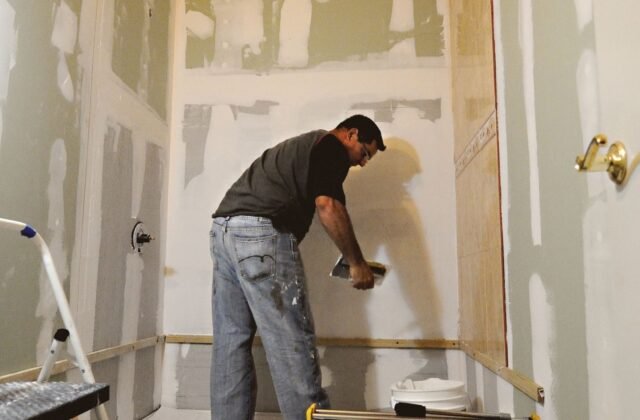
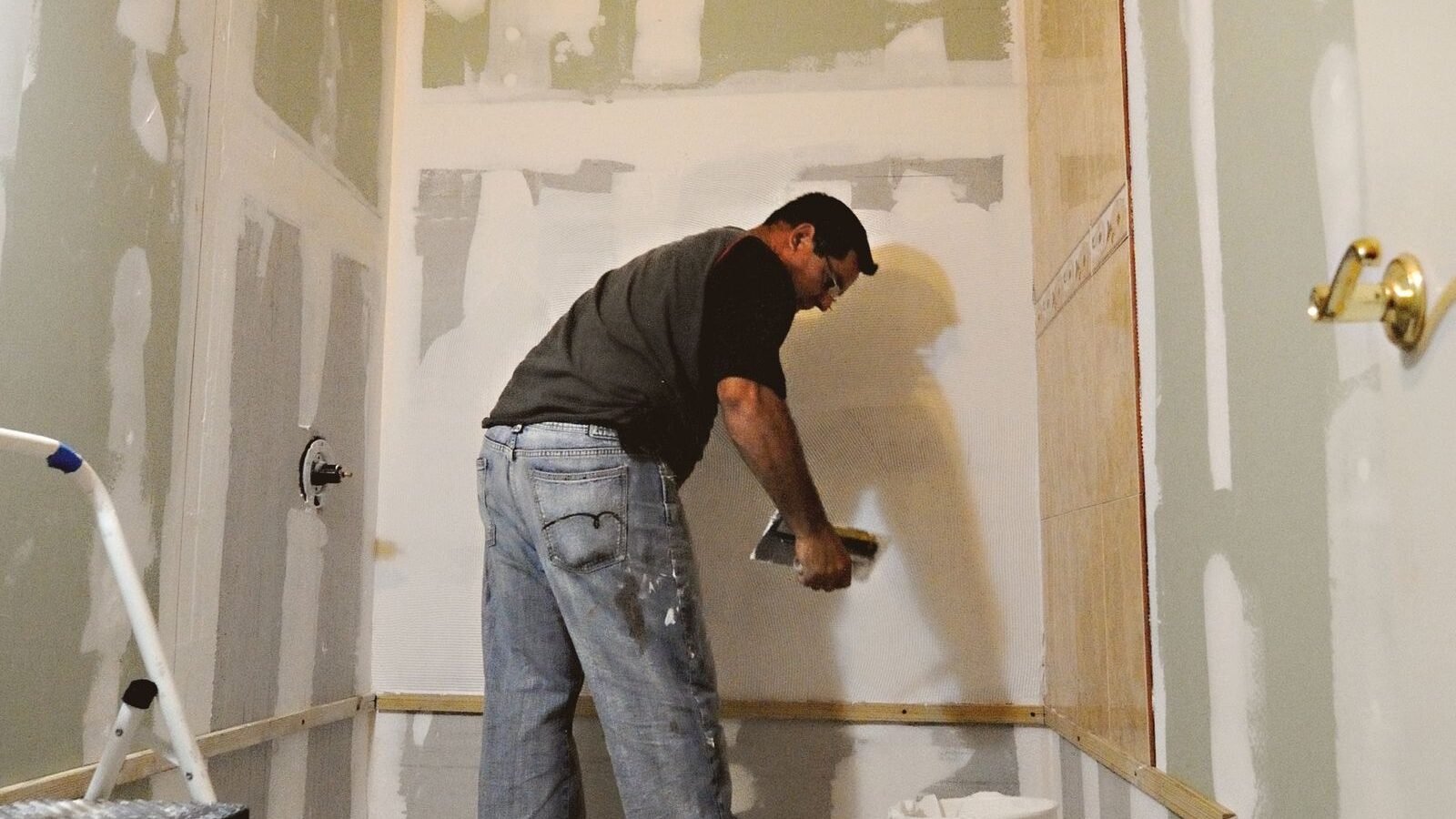
The finish check. Before priming, the homeowner kills the overheads, holds a work light at a shallow angle to each wall, and circles every flaw with a pencil — five touch-ups, one more thin skim on a butt joint, then a final light sand. Total added time: 90 minutes. Skipping that check would have meant seeing every flaw under the new flat paint anyway — just later, when fixing it costs a repaint. The raking-light habit is the cheapest quality control in drywall finishing.
The schedule. Tape coat Saturday, fill coat Sunday, dry weeknights, finish coat next Saturday, sand Sunday — two weekends plus drying days, matching the DIY vs pro timeline. Total material spend: ~$200 (buckets, tape, knives, pan, sponges, mask).
Scenario B: Whole House, Pro Crew
Hypothetical case study — illustrative example, not a real project. A contractor crew finishes a new build: 2,000 sq ft (185.8 m²) of drywall across the house, Level 4 smooth, flat paint. Two finishers, setting-type prefill plus ready-mix coats.
The estimate. 2,000 ÷ 125 = 16 gal; crew waste 10%: 16 × 1.10 = 17.6 gal → four 5-gallon buckets (20 gal). Metric cross-check: 185.8 m² × 0.326 L/m² = 60.6 L = 16.0 gal; × 1.10 = 66.6 L = 17.6 gal ✓. Compound cost: ~$140 in mud — under 3% of the finishing contract.
The schedule play. The crew prefills butt joints and bead with 45-minute setting-type on day one morning, tapes by afternoon, and runs ready-mix fill coats on day two — compressing what would be a 5-day ready-mix-only sequence into 3. The mud type choice, not the quantity, is the schedule lever — see material guide and pro tips.
The inspection beat. Before taping, the crew leaves all joints open for the drywall-nailing inspection — an inspector verifies fastener spacing per the assembly design, then releases the job for finishing. The foreman’s rule: no mud before the inspection card is signed. Taping early and failing inspection means cutting joints back open. (Inspection sequencing belongs on every job checklist for exactly this reason.)
The money. Finishing contract at ~$3/sq ft × 2,000 = ~$6,000 (typical US planning range $4,000–$8,000). Mud is the cheapest line item on the invoice — labor and schedule are what the homeowner is buying. Full breakdown in the cost guide.
Side-by-Side Comparison
| Scenario A: 2 rooms DIY | Scenario B: whole house pro | |
|---|---|---|
| Drywall area | 1,103 sq ft (102.5 m²) | 2,000 sq ft (185.8 m²) |
| Mud needed | 10.15 gal → 2 buckets + 1 carton | 17.6 gal → 4 buckets |
| Material cost | ~$200 | ~$140 (mud only) |
| Labor cost | $0 (weekends) | ~$4,000–$8,000 |
| Calendar time | 2 weekends + drying | ~3 days (crew of 2) |
| Key risk | Under-ordering; thick coats | Schedule slip; spec compliance |
Takeaways for Your Job
- Small jobs: the material cost is trivial — the risk is running short mid-job. Round up aggressively; an extra gallon is $8–$15 of insurance.
- Large jobs: mud is <5% of the finishing budget. Optimize for schedule (setting-type strategy) and spec compliance, not compound pennies.
- Both: the estimate in the estimating guide plus the waste allowance for your skill level is the whole game. Everything else is technique.
- Order timing: buy mud before tape day, not during it. Scenario A’s homeowner ordered everything up front; a mid-job supply run with wet tape drying on the wall is how good weekends go bad.
- Spec in writing: on hired work, the finish level (Level 4 vs. Level 5) belongs in the contract, not in a handshake. Scenario B’s crew bids Level 4; a Level 5 upgrade would have repriced the job.
Related Guides
- DIY vs Pro — the hiring decision framework.
- Cost Guide — material and labor price ranges.
- Estimating Guide — measuring your rooms.
- Pro Tips — technique for a pro-looking finish.
- Common Mistakes — errors that cost time and mud.
- Checklist — prep list before the first coat.
Get Your Number
Your job is one of these two shapes: a room or two on weekends, or a whole house on a schedule. Either way, the next step is the same — enter your dimensions in the Drywall Mud Calculator, apply the waste allowance for your skill level, and order with the confidence of someone who’s already seen the job done twice.
Disclaimer: Scenarios above are hypothetical illustrations, not real projects. Calculator results are planning estimates — actual material needs, costs, and schedules vary with seam density, finish level, technique, region, and site conditions. Verify quantities with your supplier and consult a licensed professional for quotes and code-related decisions.