Introduction
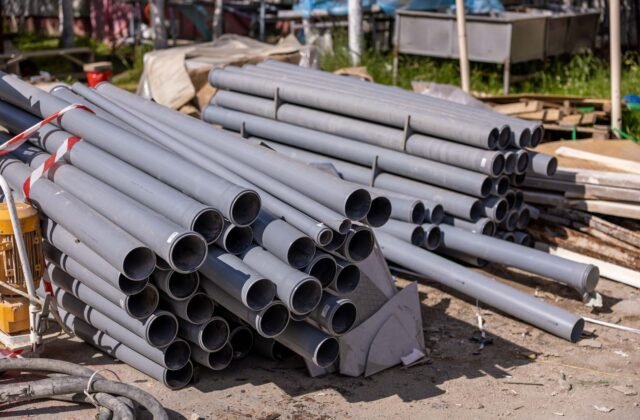
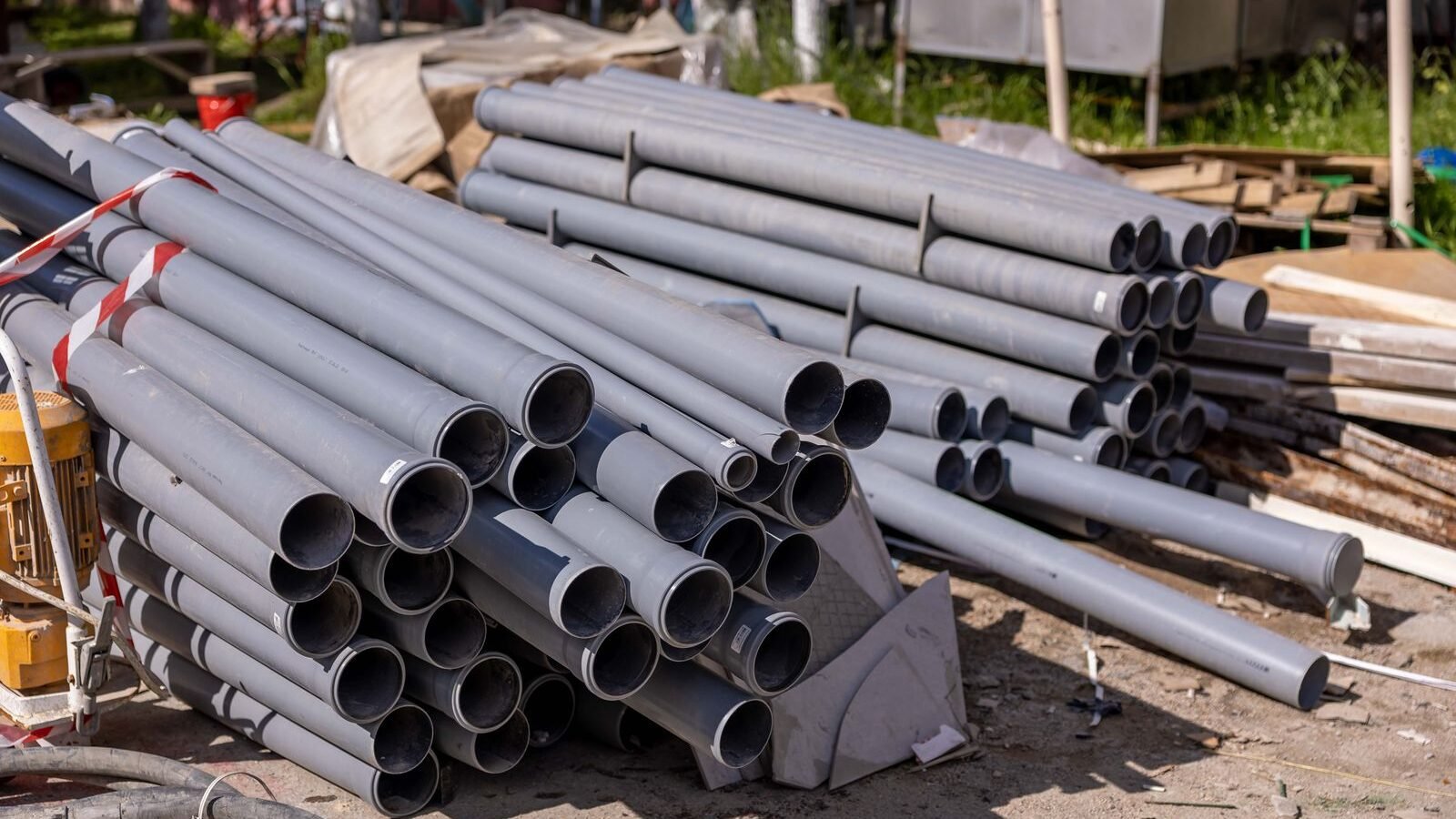
Drain pipe is not one product — it’s a family of materials with different strengths, lifespans, prices, and appropriate uses, and picking the wrong one is a mistake that takes years to surface. PVC under a slab behaves differently from corrugated pipe in a French drain; cast iron has a place modern plastics can’t fill; and the gravel and fabric around a French drain matter as much as the pipe inside it.
The Drain Pipe Calculator needs one material input — the roughness coefficient (Manning’s n) — because interior smoothness directly sets flow capacity. This guide covers every common drain pipe material, when to use each, what they cost, and the companion materials (gravel, fabric, fittings) that complete the system.
Pipe Materials Compared
| Material | Manning’s n | Typical uses | Lifespan | Relative cost |
|---|---|---|---|---|
| PVC Schedule 40 | 0.009–0.011 | Interior DWV, under-slab, building drains | 50–100 yrs | $$ |
| PVC SDR-35 | 0.009–0.011 | Buried exterior sewers, storm drains | 50–100 yrs | $ |
| ABS (black) | 0.009–0.011 | Interior DWV (where code allows) | 50+ yrs | $$ |
| Corrugated HDPE | 0.016–0.024 | French drains, landscape drainage | 50+ yrs | $ (cheapest) |
| Smooth-wall HDPE | 0.009–0.012 | Culverts, larger storm lines | 50–100 yrs | $$$ |
| Cast iron (no-hub) | 0.012–0.015 | Sound-sensitive interior stacks | 75–100 yrs | $$$$ |
| Vitrified clay | 0.012–0.015 | Legacy sewers (repairs only) | 50–100 yrs | — |
PVC: The Default Choice
Schedule 40 vs. SDR-35
Both are PVC with the same smooth interior (n ≈ 0.010) and the same flow capacity. The difference is wall thickness: Schedule 40 is thicker and rated for interior DWV (drain-waste-vent), under-slab, and exposed runs. SDR-35 is thinner-walled, cheaper per foot, and the standard for buried exterior gravity sewers — it’s designed for soil loads, not internal pressure. Don’t use SDR-35 inside a building or above ground (UV degrades PVC), and don’t pay Schedule 40 prices for a buried line that SDR-35 handles fine.
ABS
Black ABS pipe is the traditional interior DWV material in many regions — lighter than PVC, one-step cemented joints (no primer in most codes), and slightly better impact resistance in cold weather. Hydraulically identical to PVC. Some jurisdictions restrict it; check local code before buying.
Perforated vs. solid
Perforated PVC (two rows of holes, or slotted) is for collection — French drains gathering groundwater. Solid-wall pipe is for conveyance — carrying collected water to the outlet. A French drain system uses both: perforated in the collection trench, solid from the trench end to daylight. Mixing them up (solid pipe in the collection zone) is a silent, total failure.
Corrugated HDPE: Cheap but Rough
Corrugated polyethylene (the flexible black pipe) is the cheapest drain pipe per foot and the easiest to install — it bends around gentle curves without fittings. The price is interior roughness: n of 0.016–0.024 versus 0.010 for smooth pipe, which cuts capacity nearly in half at the same slope and diameter.
Use it where that tradeoff is acceptable: French drains and landscape drainage with generous slope, where capacity isn’t the constraint. Avoid it where capacity matters or cleaning will be needed — corrugations snag augers and jetter nozzles, and the pipe crushes more easily under load than rigid PVC. For a buried line that must last decades with minimal maintenance, rigid perforated PVC is usually the better value despite costing more per foot. The capacity difference is quantified in the formula-explained guide.
Cast Iron and Legacy Materials
Cast iron
Still specified where quiet matters — soil stacks running through living spaces transmit far less noise in cast iron than in plastic. It’s heavy, expensive, and needs no-hub couplings and more labor, so it’s a targeted choice (a stack, not a whole system) in residential work. Lifespan is excellent: 75–100 years.
Vitrified clay
The material of old municipal and farm sewers — you’ll encounter it when repairing or tying into an existing line, not when buying new. Clay joints are the weak point (root intrusion), which is why replacement usually transitions to PVC with a code-approved adapter coupling.
French Drain Companion Materials
Drain gravel
Use clean, washed, angular 3/4-inch stone — no fines, no dust, no crusher run. The voids between stones are the drain’s reservoir; fines fill those voids and blind the system. Buy in bulk by the cubic yard (typically $35–$65/yd³ delivered), not by the bag — bagged stone costs 3–5× more per yard. Quantity math is worked in the estimating guide.
Filter fabric
Non-woven geotextile, typically 4–6 oz weight, lining the trench before gravel goes in. It passes water while blocking silt migration — the component that determines whether the drain lasts 5 years or 25. Don’t substitute landscaping weed barrier; it’s a different product with different permeability.
Fittings
Stock the transitions your system needs: solid-to-perforated adapters, wyes for branch tie-ins, end caps, and cleanout assemblies. Use long-sweep bends for direction changes — tight 90s belong on vents, not drains. Dry-fit everything to verify grade before gluing; the pro tips guide covers joint technique.
Which Material for Which Job
- Building sewer (house to street/septic): 4-in SDR-35 PVC (or Schedule 40 where code requires). Minimum 4-inch diameter in most codes.
- Interior DWV: Schedule 40 PVC or ABS per local code; cast iron for noise-critical stacks.
- French drain: 4-in perforated rigid PVC preferred; corrugated HDPE acceptable with adequate slope. Washed stone + non-woven fabric.
- Downspout runs: 3- or 4-in solid SDR-35 or Schedule 40; corrugated acceptable for shallow landscape runs.
- Under driveways: Schedule 40 minimum — SDR-35 and corrugated can deform under vehicle loads in shallow cover.
- Repairs to clay pipe: transition with shielded no-hub or code-approved adapter couplings, then PVC.
Related Guides
- Complete Guide — sizing fundamentals: slope, diameter, and flow capacity.
- Cost Guide — what each material costs to buy and install.
- Estimating Guide — quantity takeoff for pipe, gravel, and fittings.
- Pro Tips — installation practices that protect your material choice.
- Code Compliance — approved materials and what inspectors check.
Frequently Asked Questions
Is SDR-35 or Schedule 40 better for a French drain?
Perforated Schedule 40 (or SDR-35 where available perforated) rigid PVC is the premium choice — smooth interior, crush-resistant, cleanable. Corrugated HDPE is the budget choice. Both work; the PVC lasts longer and maintains capacity.
Can I use corrugated pipe for a sewer line?
No — building sewers require smooth-wall pipe (PVC, ABS, or cast iron) under plumbing codes. Corrugated pipe is for groundwater and landscape drainage only.
How long does PVC drain pipe last underground?
50–100 years in typical soil conditions. PVC doesn’t corrode; failures are almost always mechanical (crushing, joint separation from poor bedding) rather than material degradation.
Do I need filter fabric around a French drain?
Yes, in any soil with silt or clay content — which is most soils. Fabric is cheap insurance against the number-one French drain failure mode: fines clogging the gravel.
What gravel size is best for French drains?
Clean washed 3/4-inch angular stone. Avoid pea gravel (rounds shift and pack) and crusher run (fines blind the voids).
Get Your Number
Material selection sets the roughness coefficient that drives the whole calculation — smooth PVC at n = 0.010 versus corrugated at n = 0.020 is a factor-of-two difference in capacity. Pick your material from the guidance above, enter its n value into the Drain Pipe Calculator, and size the diameter and slope against that realistic number — not the textbook best case.
Disclaimer: Material approvals vary by jurisdiction — verify that your chosen pipe material is code-approved for the application with your local building authority. Lifespan and price figures are typical ranges for planning; consult a licensed professional for sewer connections or structural-load situations like under-driveway crossings.