Introduction
Reactions and moments tell you what a beam must do — but which material should do it: steel, solid lumber, LVL, or glulam? The answer shapes cost, depth, weight, installation, and appearance, and the wrong choice at the planning stage is expensive to reverse. Each material carries load differently: different stiffness, different self-weight, different span capability, different failure behavior.
The Beam Load Calculator is material-agnostic — it computes the demands (reactions in lb or kN, moments in lb-ft or kN·m) that any candidate material must satisfy. This guide compares the four common beam materials on the properties that matter for load-carrying, so you arrive at the engineer’s office with an informed preference instead of a blank slate.
How Materials Carry Load: The Three Properties
Every beam material is judged on three structural properties:
- Strength — how much bending moment and shear the cross-section can resist before failing. Higher strength means a smaller section for the same moment.
- Stiffness (E) — how much the material resists deflecting under load, quantified by the modulus of elasticity. Stiffness controls the bouncy-floor problem far more than strength does.
- Self-weight — the beam’s own UDL, which adds to the loads it carries. Heavy materials tax themselves; light ones don’t.
A licensed engineer combines these with span, load duration, moisture, lateral bracing, and code provisions to select the actual section. Your role is understanding the trade-offs well enough to discuss options intelligently — never to pick the final section yourself. The demands themselves — reactions and moments — are computed as shown in the complete guide, and the pro tips guide covers presenting your analysis effectively.
Dimensional Lumber (Solid Sawn)
Built-up beams of 2×10s or 2×12s nailed or bolted together — the traditional residential choice.
- Strengths: cheapest per foot ($8–$15 typical), available everywhere, easy to cut and connect with ordinary carpentry tools, light enough to handle without equipment on short spans.
- Weaknesses: limited span capability; natural defects (knots, wane, splits) reduce reliable capacity; shrinks and can twist as it dries; deep built-up sections get heavy and hard to maneuver.
- Load behavior: adequate for short spans and light loads; deflection usually governs before strength on longer runs — the beam feels bouncy before it’s anywhere near failing.
- Best for: short-span headers, garage door openings, light floor girders where depth isn’t constrained.
LVL (Laminated Veneer Lumber)
Engineered from laminated wood veneers — stronger, stiffer, and far more consistent than solid lumber of the same depth.
- Strengths: high strength-to-depth ratio; dimensionally stable (won’t twist or shrink meaningfully); predictable properties with published design values; spans considerably farther than solid lumber at the same depth.
- Weaknesses: costs more per foot ($12–$25 typical); heavy in long lengths — a 20 ft LVL is a multi-person or mechanical lift; must be kept dry; field modifications (notching, drilling) are restricted by manufacturer rules.
- Load behavior: the default choice for residential floor girders carrying significant UDL — it converts the wL²/8 moment into a shallower, reliable section.
- Best for: floor beams, ridge beams, and headers where span exceeds what solid lumber handles gracefully.
Glulam (Glued Laminated Timber)
Laminated dimension lumber glued into large sections — the engineered-wood option for long spans and exposed architecture.
- Strengths: longest wood spans available; attractive enough to leave exposed (architectural grades); good strength-to-weight ratio; custom cambers and curved shapes possible.
- Weaknesses: highest wood cost per foot ($18–$35 typical); long lead times for custom sizes; heavy — installation usually needs equipment; connections need careful detailing.
- Load behavior: excels where both moment and appearance matter — great rooms, exposed ridge beams, commercial-ish residential spans.
- Best for: long clear spans, exposed structural timber, architecturally visible beams.
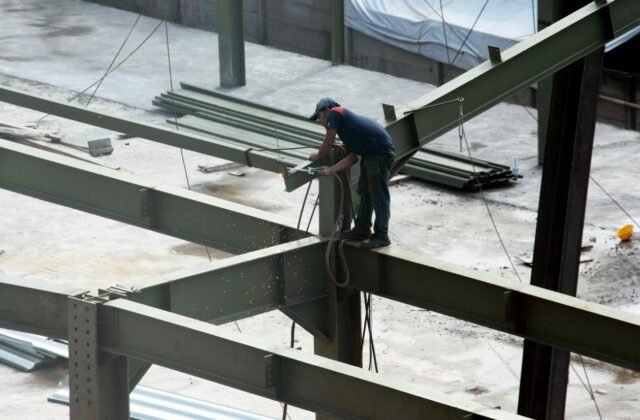
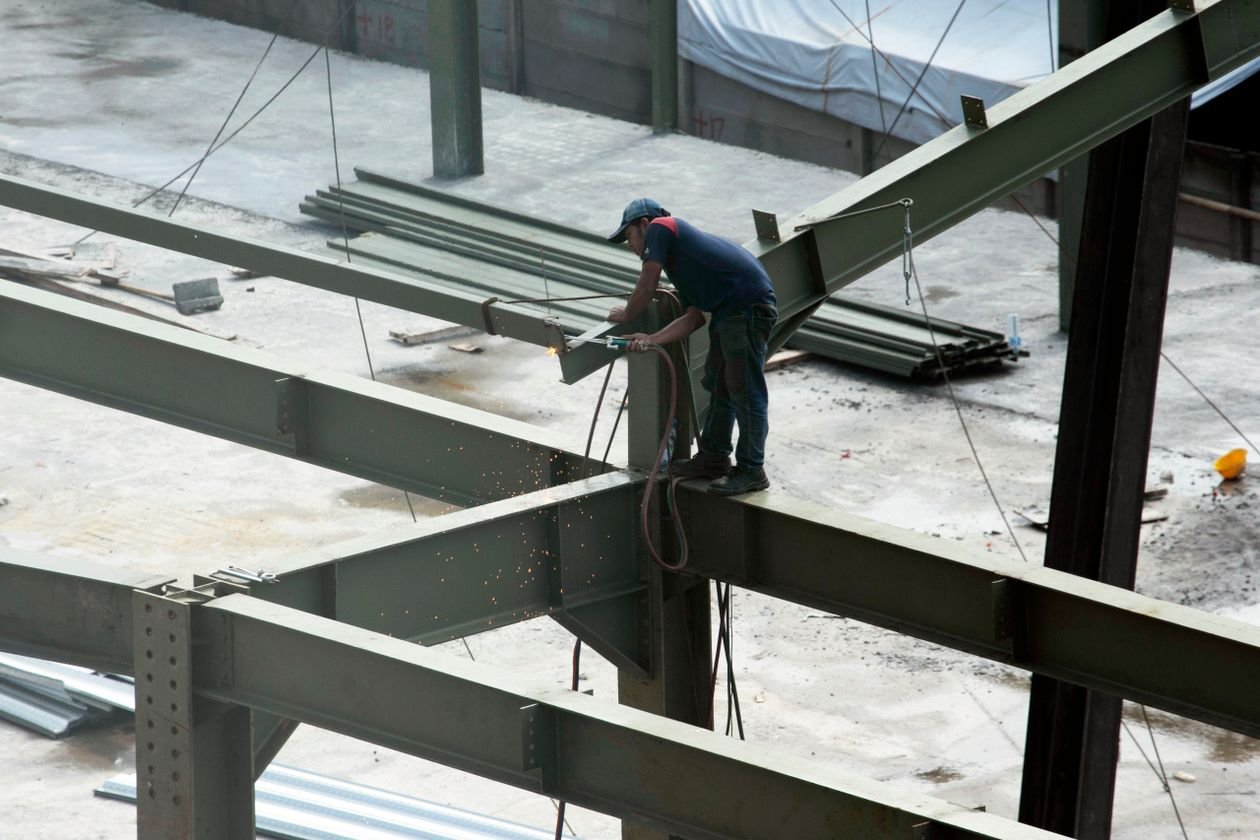
Structural Steel (Wide-Flange Beams)
Hot-rolled I-shaped sections (W-shapes) — the highest capacity per inch of depth.
- Strengths: strongest and stiffest option at a given depth — carries the heaviest moments in the shallowest profile; very long spans possible; non-combustible; dimensionally perfect.
- Weaknesses: highest material cost per foot ($20–$45 typical, plus fabrication); very heavy — always a mechanical lift; needs fire protection in many applications; thermal bridging in exterior walls; connections require welding or bolting expertise.
- Load behavior: self-weight is significant (a W10×22 weighs 22 lb/ft — a real UDL to include); the shallow-depth advantage matters most where headroom is precious, like basement retrofits.
- Best for: heavy point loads, long spans with limited depth, commercial loads, basement beam replacements where every inch of headroom counts.
Head-to-Head Comparison
| Property | Solid lumber | LVL | Glulam | Steel |
|---|---|---|---|---|
| Typical material cost | $8–$15/ft | $12–$25/ft | $18–$35/ft | $20–$45/ft |
| Span capability | Short | Medium–long | Long | Longest at given depth |
| Depth needed for a given moment | Deepest | Moderate | Moderate | Shallowest |
| Self-weight | Light | Moderate | Moderate–heavy | Heavy |
| DIY-friendliness | High | Moderate | Low | Low |
| Appearance exposed | Rustic | Utilitarian | Excellent | Industrial |
Costs are typical US material-only ranges — the installed picture is in the cost guide, where labor and engineering usually dwarf the material line.
Matching Material to Your Numbers
Use your calculator outputs as the conversation starter with each material:
- High moment, limited depth (basement retrofit, low headroom) → the shallow-depth advantage points toward steel; get an engineer’s take before assuming.
- Moderate moment, long span, concealed (floor girder in a crawlspace) → LVL is the workhorse; compare its installed cost against steel.
- Long span, visible beam (great room ridge) → glulam’s appearance and span capability justify its premium.
- Short span, light load (window header, small opening) → solid lumber is economical and entirely adequate.
- Heavy concentrated loads (post from above landing midspan) → point-load moments (PL/4) punish wood depth fast; price steel alongside engineered wood.
Whatever you lean toward, the final selection — section size, grade, bracing, connections, bearing — is structural design. Bring your reactions, moments, and material preference to a licensed engineer; the case study shows how this conversation plays out on a realistic project.
Related Guides
- Beam Cost Guide — what each material costs installed, with a full worked budget.
- Complete Guide — the reactions and moments every material choice starts from.
- Pro Tips — presenting your numbers and preferences to an engineer effectively.
- Beam Load Case Study — material selection on a hypothetical realistic project.
- Beam Load Calculator FAQ — quick answers to common questions.
Choose Informed, Decide With an Engineer
Material choice is where your load numbers meet the real world: compute your reactions and moment with the Beam Load Calculator, weigh the trade-offs above against your span, depth, budget, and appearance needs, and bring a shortlist — not a verdict — to a licensed structural engineer. Informed preferences make for fast, cheap engineering; premature verdicts make for expensive corrections.
Disclaimer: Material comparisons here are educational overviews for planning purposes, not design recommendations. Beam sizing, material selection, and connection design require a licensed structural engineer and must comply with your local building code and authority having jurisdiction.