Introduction
Anyone can buy 2x6s. Buying good 2x6s — straight, dry, correctly graded, and in the right lengths for the wall — is what separates a smooth framing job from a week of fighting twisted studs. These pro tips cover buying, grading, handling, and storing 2×6 lumber, plus how to tell when 2×6 framing genuinely pays off versus when it’s wasted money.
Start with your numbers: the 2×6 Lumber Calculator turns your wall dimensions into an exact board list, so you can buy with a list instead of a guess. For species and grade selection, pair this guide with the material guide.
Buying: Get the Yard Working for You
Buy from your list, not from the pile. Walk in with the calculator’s board list — studs by length, plate boards by length, header stock — and you’ll buy 10% less than the “grab a bunk and hope” approach. Lumberyards also quote full framing packages at 10–20% below shelf prices; for anything bigger than a single wall, get a package quote from two yards.
Hand-pick every stud. Sight down each board’s edge like a rifle barrel. Reject anything with more than about 1/2 in (13 mm) of bow or crook in 8 ft (2.44 m), twist you can see, or large knots on the edge (knots on the wide face are less critical for studs). For plates, straighter matters more than for studs — a bowed plate telegraphs into the whole wall.
Buy 10% more than the math says. The waste allowance in your estimate isn’t pessimism — it’s the cull pile. On delivery day, immediately set aside the worst 5–10% for blocking, cripples, and fire stops, and frame walls with the best stock. Short cutoffs from plates and headers become cripple studs and blocking, so sort cutoffs by length as you work.
Grading at the Rack: Read the Stamp
Every structural 2×6 carries a grade stamp: species (or species group like SPF), grade (No. 2, Stud, No. 1), moisture content (KD for kiln-dried, HT for heat-treated), and the grading agency. Tips:
- Stud grade is the economical workhorse for vertical studs — graded specifically for that use.
- No. 2 is the general framing grade; fine for studs, plates, and headers in most residential work.
- No. 1 costs more and buys you fewer defects — worth it for long plates or tall walls where straightness matters.
- KD (kiln-dried) stock is more stable than green lumber — it has already done most of its shrinking and twisting. For interior framing, always buy KD.
- Check that all boards in a wall are the same species — mixing species mixes shrinkage behavior and nail-holding.
Grade and species trade-offs in full are in the material guide; the estimating errors that bad stock causes are catalogued in the common mistakes guide.
When 2×6 Pays Off — and When It Doesn’t
2×6 pays off for:
- Exterior walls in insulated construction. The 5.5 in (140 mm) cavity fits R-19 batts versus R-13 in a 2×4 wall — the primary reason 2×6 is standard for exterior walls in colder climate zones.
- Tall walls. 10–12 ft (3.05–3.66 m) walls are noticeably stiffer in 2×6; a 2×4 stud that tall can feel springy.
- Load-bearing walls with heavy loads. Two-story bearing walls, walls carrying long roof spans, and high-wind or seismic zones benefit from the extra section.
- Walls carrying plumbing or ductwork. A 2×6 wall swallows a 3 in (76 mm) drain pipe or a dryer vent without notching the studs to nothing.
2×6 is wasted money for:
- Interior non-bearing partitions. No insulation need, no load — 2×4 does the job for ~40% less per board.
- Short non-structural walls like closet liners and soffits.
- Anywhere the extra depth fights you — door jamb extensions, window returns, and trim all get more complicated at 5.5 in (140 mm) of wall depth.
Rule of thumb: exterior and load-bearing in 2×6, interior partitions in 2×4, unless a specific need (plumbing, sound insulation) says otherwise.
Handling and Storage: Keep Them Straight
Lumber starts moving the moment it leaves the yard. Storage discipline protects your money:
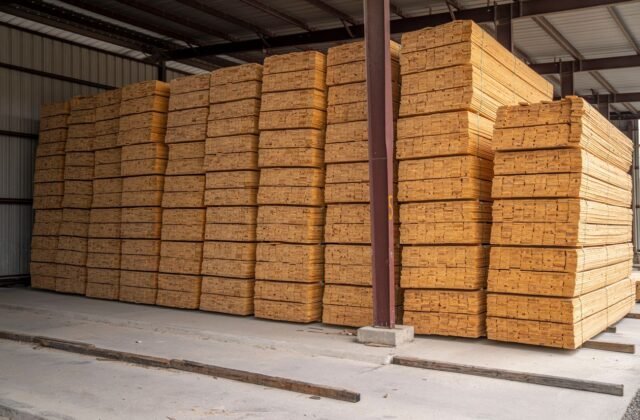
- Stack flat on level stickers. Lay boards on evenly spaced cross-stickers (scrap 2×4 works) on flat ground — never directly on soil or an uneven driveway. Keep stickers vertically aligned in each layer so weight transfers straight down.
- Keep it dry and covered. A tarp over the top with air circulation at the sides beats a tarp wrapped tight (which traps moisture). Standing water under the stack wicks into end grain fast.
- Frame promptly. Every week a stack sits is a week it can twist. If the schedule slips, re-tighten banding and check the stack is still level.
- Cut the crown consistently. Every stud has a slight crown (bow along its edge). When framing, install all studs crown-up or crown-out the same way — the wall stays flat instead of wavy.
- Two-person the long ones. 16–20 ft (4.88–6.10 m) 2x6s are unwieldy solo; dragging them solo scuffs edges and risks a back injury. An 8 ft (2.44 m) stud at 10–13 lb (4.5–6 kg) is a one-person carry.
Cutting and Fastening Tips
- Gang-cut studs. Clamp or stack studs and cut a whole wall’s worth to identical length in one pass — faster and more consistent than measuring each one.
- Cut plates 1/8 in (3 mm) long, not short. A plate a hair long can be trimmed; a plate short leaves a gap at the corner.
- 16d nails for framing (3.5 in / 89 mm) — the standard for joining 2×6 to 2×6. Use 8d (2.5 in / 64 mm) for sheathing. Ring-shank nails hold better in shear walls if your design calls for them.
- Pre-drill near ends when nailing within a couple inches of a board end to avoid splitting, especially in drier KD stock.
- Don’t rip 2x6s for structural members. Ripping a 2×6 down the middle destroys its grade stamp rating — the remaining pieces are no longer graded lumber. Buy the size you need.
Related Guides
- Material Guide — SPF vs. Douglas fir, grades, kiln-dried, and engineered alternatives like LVL.
- Complete Guide — the full overview of 2×6 estimating, from dimensions to order list.
- Common Mistakes — the errors that waste lumber and money, with fixes.
- Cost Guide — typical price ranges and a full wall cost breakdown.
- Pre-Order Checklist — verify species, grade, lengths, and quantities before delivery.
- DIY vs. Pro — when to frame it yourself and when to hire a crew.
Get Your Number
The best lumber deal is a precise list: exact stud counts by length, plate boards by length, header stock, and a 10% waste allowance — bought as a package quote from a yard that lets you hand-pick. Generate that list with the 2×6 Lumber Calculator, verify species and grade against the pre-order checklist, and your 2x6s will arrive straight, dry, and ready to frame.
Disclaimer: Calculator results are planning estimates based on the dimensions you enter. Actual lumber requirements vary with framing details, openings, species, and cutting waste, and prices vary by region and market conditions. Verify quantities and grading requirements with your lumber supplier, and consult a licensed professional or your local building authority for structural or code-related decisions.