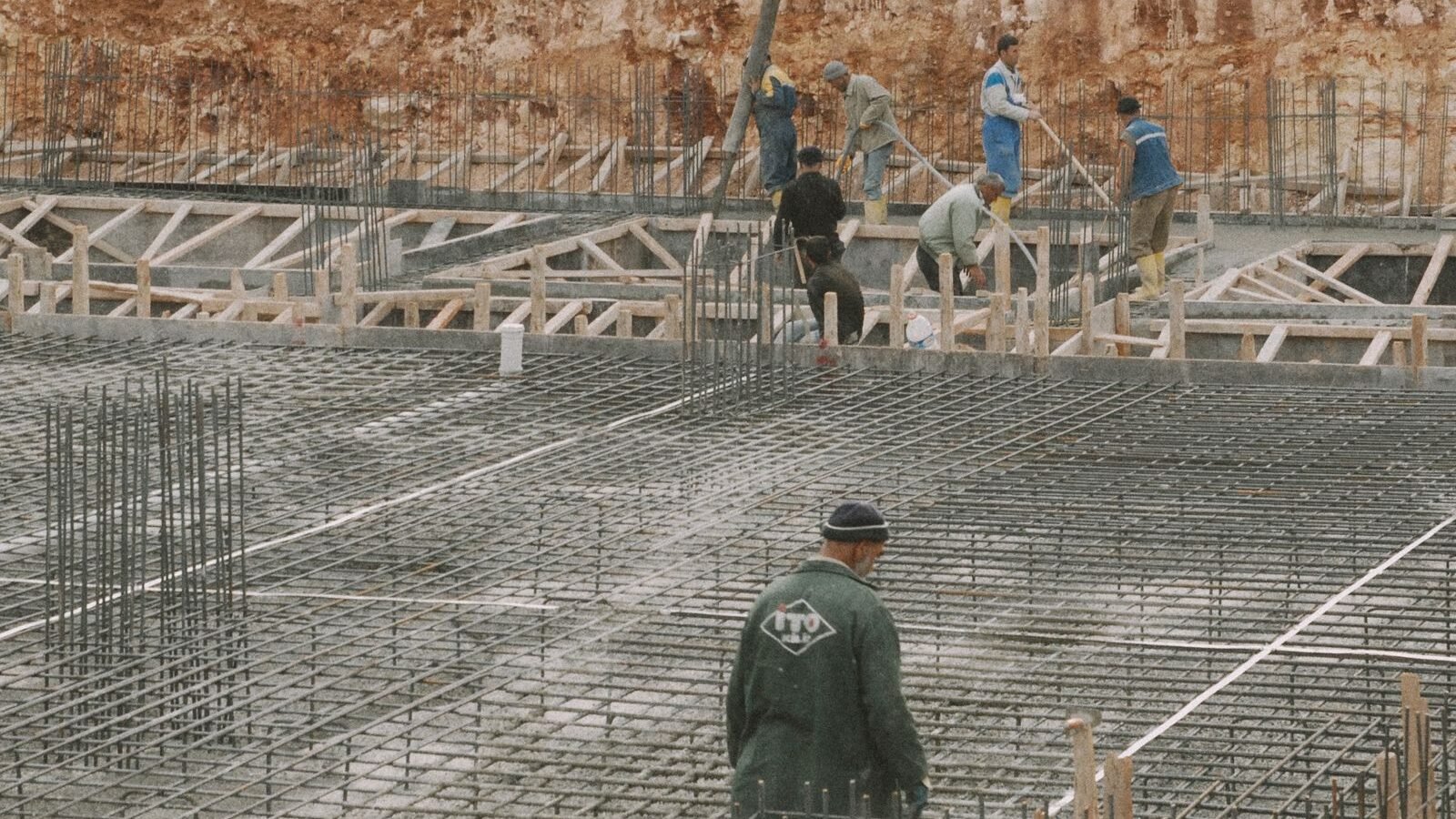
A short concrete load can mean a cold joint in the slab, a second delivery fee, or a lost day. The entire estimate for a rectangular slab or footing reduces to a single equation. The Concrete Calculator applies exactly this math — four inputs produce cubic meters, cubic yards, and the 80-lb bag count. This guide defines each symbol, works through two examples with every step shown, and covers the unit conversions where estimates most often go wrong.
The Core Formula
For any rectangular pour, the concrete volume is:
V = L × W × T × (1 + p)
- V — volume of concrete required (in m³ if metric inputs are used, ft³ if imperial)
- L — length of the pour area
- W — width of the pour area
- T — thickness (depth) of the concrete
- p — waste allowance as a decimal; the calculator defaults to 0.10 (10%)
The footprint area (L × W) times the depth (T) gives net volume; (1 + p) then adds contingency for spillage, form deflection, and subgrade variation.
The thickness unit trap: L, W, and T must be in the same unit before multiplying. Plans almost always state thickness in different units than length and width — centimeters against meters, or inches against feet. Convert first: 10 cm ÷ 100 = 0.1 m; 4 in ÷ 12 = 0.333 ft. This unit mismatch is the most common arithmetic error in concrete estimating; see the guide to common concrete estimating mistakes for more.
Where the Formula Comes From
This is the volume of a rectangular prism: the footprint area (L × W) times the depth (T). A 10 m × 10 m slab has a 100 m² footprint; at 0.1 m thick, that is 10 cubic meters of concrete.
The waste factor is not geometry; it is an estimating convention — spillage, form deflection, and subgrade variation. Multiplying by (1 + p) prices that into the order instead of discovering it mid-pour.
Non-rectangular shapes use the same principle with a different base-area formula. A round column or pier footing uses V = πr²h — the circle’s area times its height — with the same waste allowance.
Worked Example 1 — A 10 m × 10 m Slab
A 10 m × 10 m slab, 10 cm thick, with the default 10% waste allowance. (The manual takeoff process is covered in how to estimate concrete.)
- Convert the thickness: 10 cm ÷ 100 = 0.1 m. All three dimensions are now in meters.
- Net volume: 10 × 10 × 0.1 = 10 m³.
- Add waste: 10 × 1.10 = 11 m³.
- Convert to cubic yards: 11 ÷ 0.7645549 = 14.3875 → 14.39 yd³ (rounded only at the final step).
- Bags of 80-lb mix: 11 ÷ 0.017 = 647.06 → round up to 648 bags. (See the concrete material guide for bag sizes and mix types.)
Imperial cross-check. The same slab: 10 m = 32.81 ft and 10 cm = 3.94 in. Thickness in feet: 3.94 ÷ 12 = 0.3283 ft. Computing with full precision: 353.15 ft³ ÷ 27 = 13.08 yd³; × 1.10 = 14.39 yd³. Both routes agree — a built-in self-check.
Worked Example 2 — A Strip Footing
Formulas must also hold for long, narrow pours. Take a footing 20 m long, 0.6 m wide, and 0.3 m deep:
- Net volume: 20 × 0.6 × 0.3 = 3.6 m³.
- Add waste: 3.6 × 1.10 = 3.96 m³.
- Cubic yards: 3.96 ÷ 0.7645549 = 5.1795 → 5.18 yd³.
- Bags: 3.96 ÷ 0.017 = 232.94 → round up to 233 bags.
Unit Handling and Conversions
The calculator accepts metric or imperial inputs, but the formula itself is unit-agnostic — it works in any consistent system. These are the conversions it applies internally:
| Conversion | Factor |
|---|---|
| Centimeters → meters | ÷ 100 |
| Inches → feet | ÷ 12 |
| Meters → feet | × 3.28084 |
| Inches → centimeters | × 2.54 |
| Cubic meters → cubic yards | ÷ 0.7645549 |
| Cubic feet → cubic yards | ÷ 27 |
| 80-lb bag yield | ≈ 0.017 m³ (≈ 0.60 ft³) |
Two traps cause most errors. First, the thickness mismatch above: 20 × 30 ft at 4 in thick is 20 × 30 × (4 ÷ 12) = 200 ft³, not 20 × 30 × 4. Second, volume units do not convert like length units: 1 yd³ = 0.7645549 m³ (the linear factor 0.9144, cubed).
How the Calculator Applies This Formula
Each calculator input maps directly to one formula variable:
- Length → L (meters in metric mode, feet in imperial mode)
- Width → W (meters in metric mode, feet in imperial mode)
- Thickness → T (enter centimeters in metric mode, inches in imperial mode; the calculator converts to meters or feet internally)
- Waste % → p (default 10; adjustable for uneven subgrades or complex forms)
The outputs are volume in m³, volume in yd³, and the 80-lb bag count (always rounded up). For a start-to-finish walkthrough of entering a real project, see the Concrete Calculator complete guide.
Edge cases: zero or negative inputs produce meaningless zero or negative volumes — a data-entry error. Thickness must be positive; re-check any result that looks unexpectedly small or large.
Frequently Asked Questions
What is the formula for calculating concrete?
For a rectangular slab or footing: V = L × W × T × (1 + p) — length, width, and thickness in the same units, with p as the waste decimal (0.10 for 10%). Round shapes use V = πr²h with the same waste factor.
How much extra concrete should I order for waste?
The calculator defaults to 10%, a widely used contingency for spillage, form deflection, and over-excavation. The percentage is adjustable for irregular shapes or soft subgrades.
How many 80-lb bags of concrete are in a cubic yard?
About 45, before waste. One cubic yard is 0.7645549 m³ and an 80-lb bag yields roughly 0.017 m³: 0.7645549 ÷ 0.017 = 44.97, which rounds up to 45 bags.
Why must the bag count be rounded up instead of rounded normally?
Partial bags cannot be purchased, and a short pour cannot wait — concrete begins to set, and a second delivery breaks the slab with a cold joint.
What is the concrete formula in imperial units?
Volume in cubic yards = (Lft × Wft × Tin ÷ 12) ÷ 27 × (1 + p). Dividing inches by 12 converts thickness to feet; dividing cubic feet by 27 converts to cubic yards.
Estimate disclaimer: Figures on this page are planning estimates only. Actual concrete required varies with formwork accuracy, subgrade settlement, spillage, and supplier batching. Confirm final quantities with your contractor or ready-mix supplier before ordering.
Related Guides
- Concrete Cost Guide
- Concrete Pro Tips
- Concrete Calculator FAQ
- DIY vs. Pro Concrete Work
- Concrete Code Compliance
- Concrete Pour Checklist
Run your own numbers through the Concrete Calculator: enter length, width, thickness, and waste percentage to get cubic meters, cubic yards, and the 80-lb bag count in seconds.


1 comment